Chicagoland Autumn Driving Prep: Tire Tread and All-Wheel Drive Maintenance for Cadillac SUVs
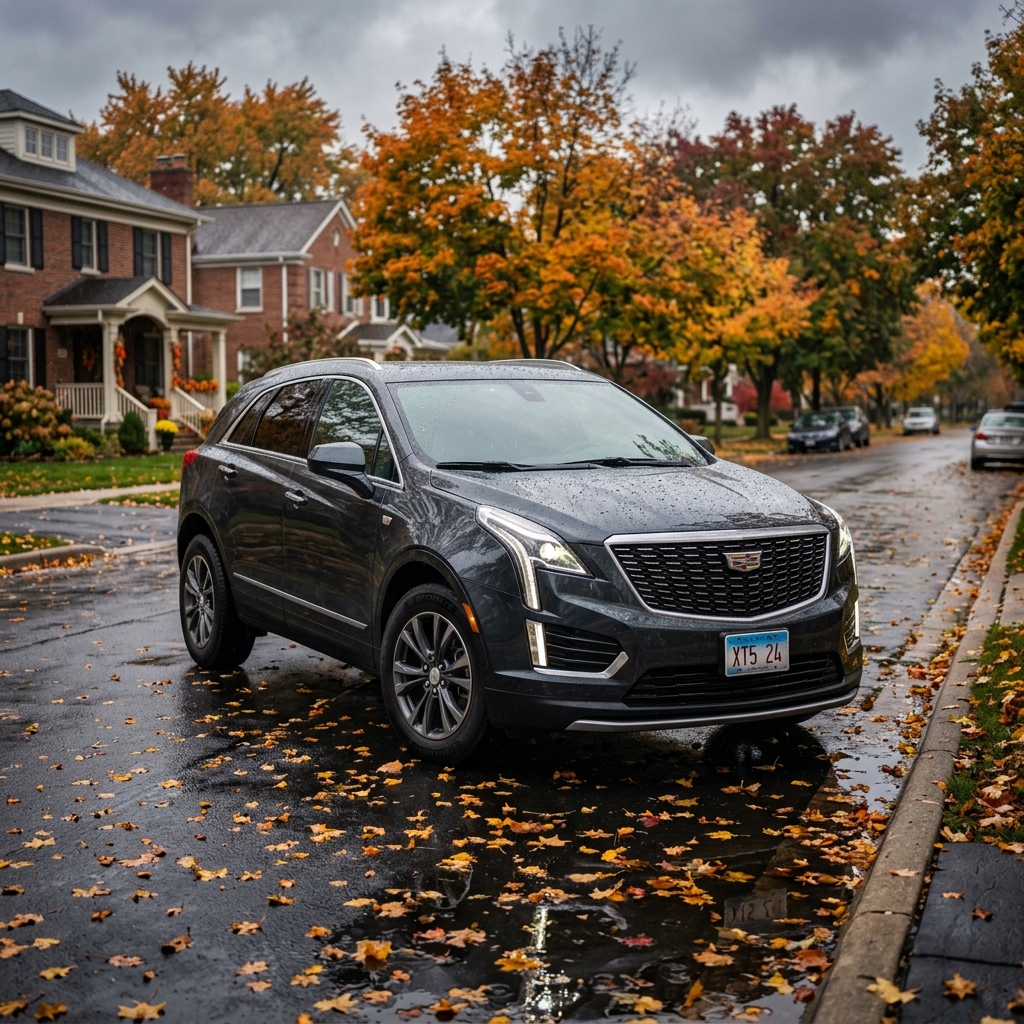
As autumn takes hold across Will County, driving conditions throughout Joliet, Plainfield, and Naperville transition rapidly. Early morning cold snaps bring slick frost, heavy rains turn fallen leaves into treacherous grease, and late-fall cold fronts introduce early slush along major corridors like I-55, I-80, and Route 59. For drivers behind the wheel of a luxury vehicle like the Cadillac Escalade, XT5, XT6, or LYRIQ, maintaining exceptional traction requires understanding how rubber compounds and tread depth interact with sophisticated All-Wheel Drive (AWD) systems.
The core question every Chicagoland Cadillac owner must answer before winter arrives is simple: At what specific tread depth threshold should all-season tires be replaced? While Illinois state law permits tires to be driven down to a legal minimum of 2/32" of tread depth, waiting for this absolute limit poses severe safety hazards on wet or slushy roads. Because luxury crossovers and full-size SUVs carry substantial curb weights—often between 4,300 and nearly 6,000 pounds—they demand significantly more hydroplaning resistance and stopping power than lighter passenger sedans.
Automotive engineering data demonstrates that 4/32" is the absolute replacement threshold for wet fall driving, while 5/32" is recommended if you plan to navigate early winter slush and snow without swapping to dedicated winter tires. Replacing tires at these realistic thresholds preserves critical water evacuation channels, protects your vehicle’s advanced StabiliTrak and active twin-clutch AWD systems from uneven circumference strain, and maintains predictable stopping performance when you need it most. If you are considering upgrading your vehicle this season, feel free to Browse New Inventory to explore the latest Cadillac AWD models.
2/32" vs 4/32" vs 6/32": The Critical Tread Depth Numbers for Will County Winters
To understand why 4/32" is the recommended replacement point for fall rain and hydroplaning protection, it helps to break down tire tread measurements in 1/32-inch increments. New all-season tires typically ship with 10/32" to 11/32" of tread depth. As the rubber wears away through daily driving along Essington Road or Jefferson Street, the channels designed to channel standing water away from the contact patch grow shallower.
6/32" Tread Depth — Peak Evacuation: At 6/32", your tire maintains approximately 80% to 90% of its original hydroplaning resistance and snow-biting capabilities. Deep circumferential grooves easily process heavy rain at 65 mph on I-55, pumping up to 8 gallons of water per second away from the tire footprint.
4/32" Tread Depth — The Wet Weather Safety Threshold: At 4/32", water evacuation efficiency drops dramatically. The remaining groove volume struggles to clear heavy water sheets during intense autumn downpours. Stopping distances on wet roads expand by up to 25 to 30 feet compared to new tires. This is the precise point where tire manufacturers and master technicians recommend replacing all-season tires before wet weather turns into freezing slush.
2/32" Tread Depth — The Legal Limit (Severe Safety Hazard): At 2/32", the wear bars molded into the tread grooves sit completely flush with the surrounding rubber. A tire at 2/32" has effectively zero ability to disperse water or grip slush. Riding on 2/32" tires in a heavy vehicle like a Cadillac Escalade during a sudden cold rain event turns the vehicle into a hydroplaning hazard.
How Wet Leaves, Rain, and Slush on Route 59 Impact Cadillac Hydroplaning Risks
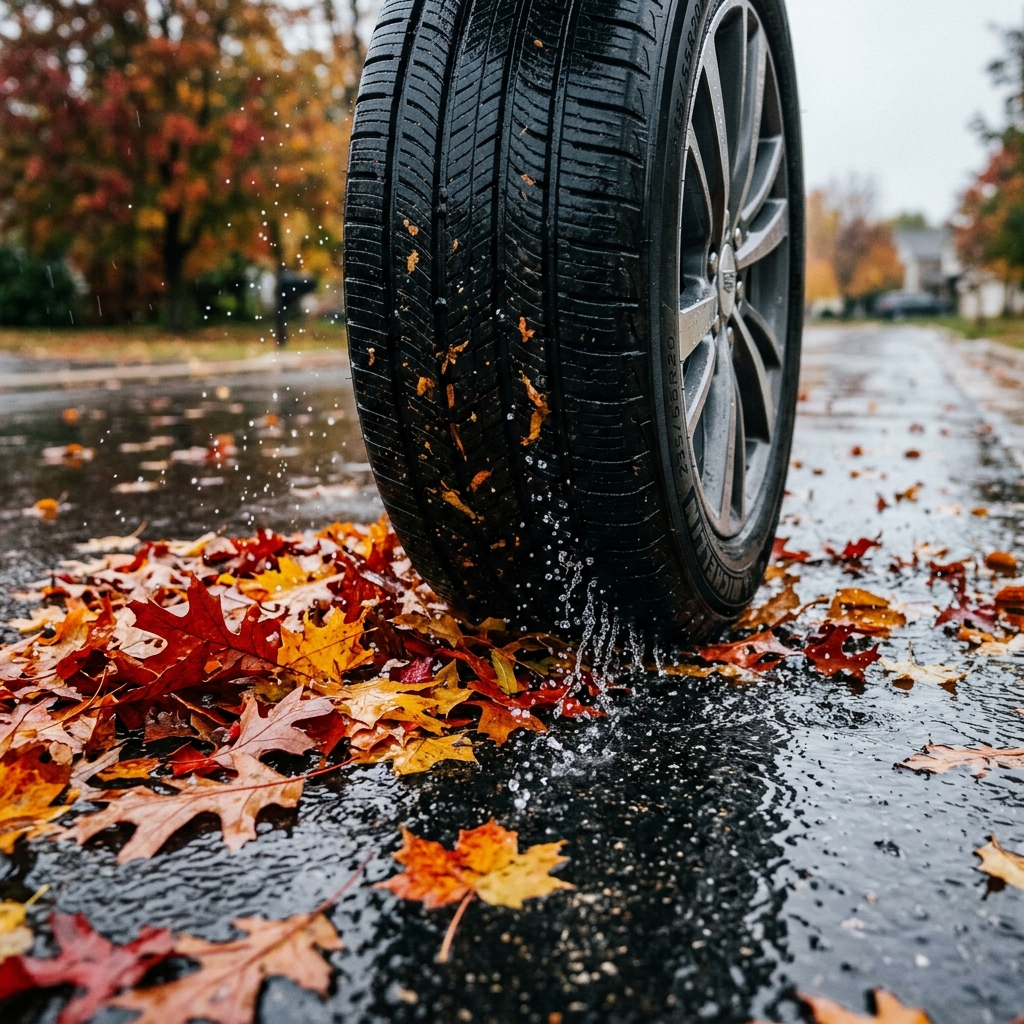
Commuters traveling daily between Joliet, Plainfield, and Naperville along Route 59 face a specific combination of road hazards every autumn. As deciduous trees shed leaves across suburban roads, wet fallen leaves collect in low-lying intersections and road shoulders. When compressed by automobile traffic and saturated with rain, these leaf layers release organic oils, creating a surface layer with a coefficient of friction almost as low as wet ice.
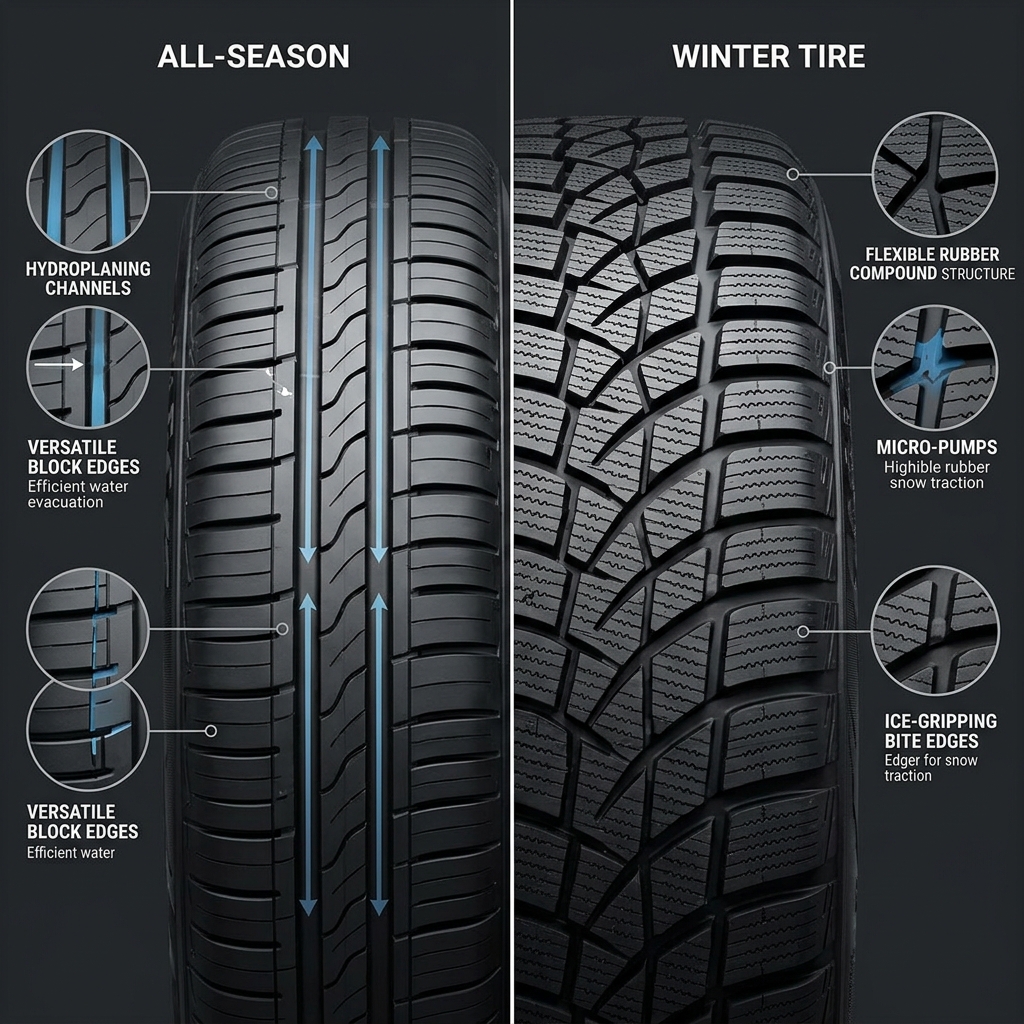
Dynamic hydroplaning occurs when water builds up ahead of your tire faster than the tread can clear it. The wedge of water lifts the tire contact patch off the asphalt, causing a total loss of steering and braking control. Deep tread sipes—tiny slit-like incisions in the tread blocks—are specifically designed to flex and create biting edges that cut through wet leaf film and channel water away. When tread depth drops below 4/32", these sipes lose depth and flexibility, leaving your Cadillac SUV vulnerable to unexpected hydroplaning during morning commutes.
Testing Your Tread at Home: Coin Tests vs Professional Depth Gauges
The Penny Test (2/32")
Insert a U.S. penny upside down into several tread grooves with Abraham Lincoln’s head facing you. If Lincoln’s entire head remains visible, your tires are at or below 2/32" of tread depth. They are legally worn out and represent an immediate safety hazard in wet or cold weather.
The Quarter Test (4/32")
Insert a Washington quarter head-first into the tread grooves. If the top of George Washington’s head is covered by rubber, you have at least 4/32" of remaining tread depth. If his head is entirely visible, your tires have worn past the wet-weather threshold and should be replaced.
Digital Depth Gauges
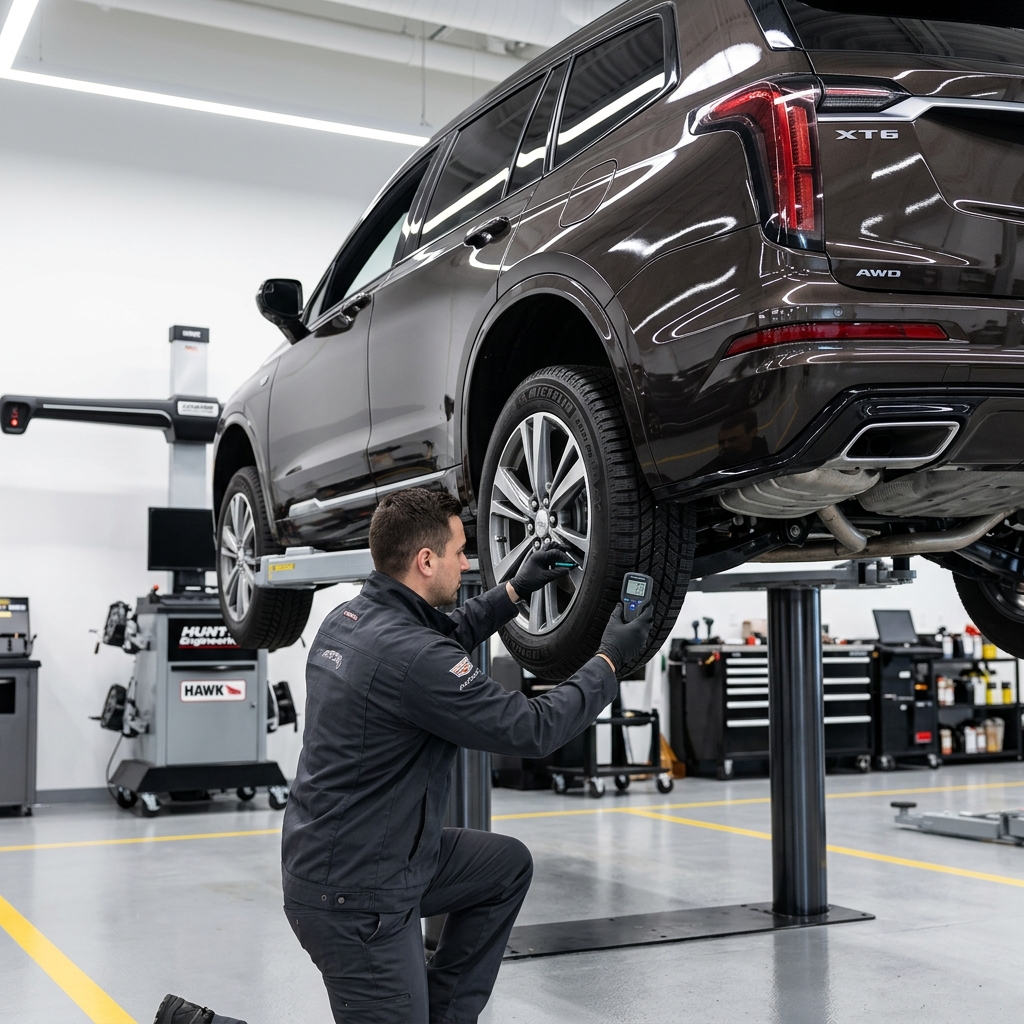
A digital tire tread depth gauge provides exact measurements in 32nds of an inch. Measure across three distinct locations on each tire: the outer shoulder, center rib, and inner shoulder. Variations between inner and outer ribs indicate wheel alignment or suspension issues. Schedule Your Service Today for a comprehensive tire health check.
How Often Should Tires Be Rotated on an AWD Cadillac Escalade or XT6?
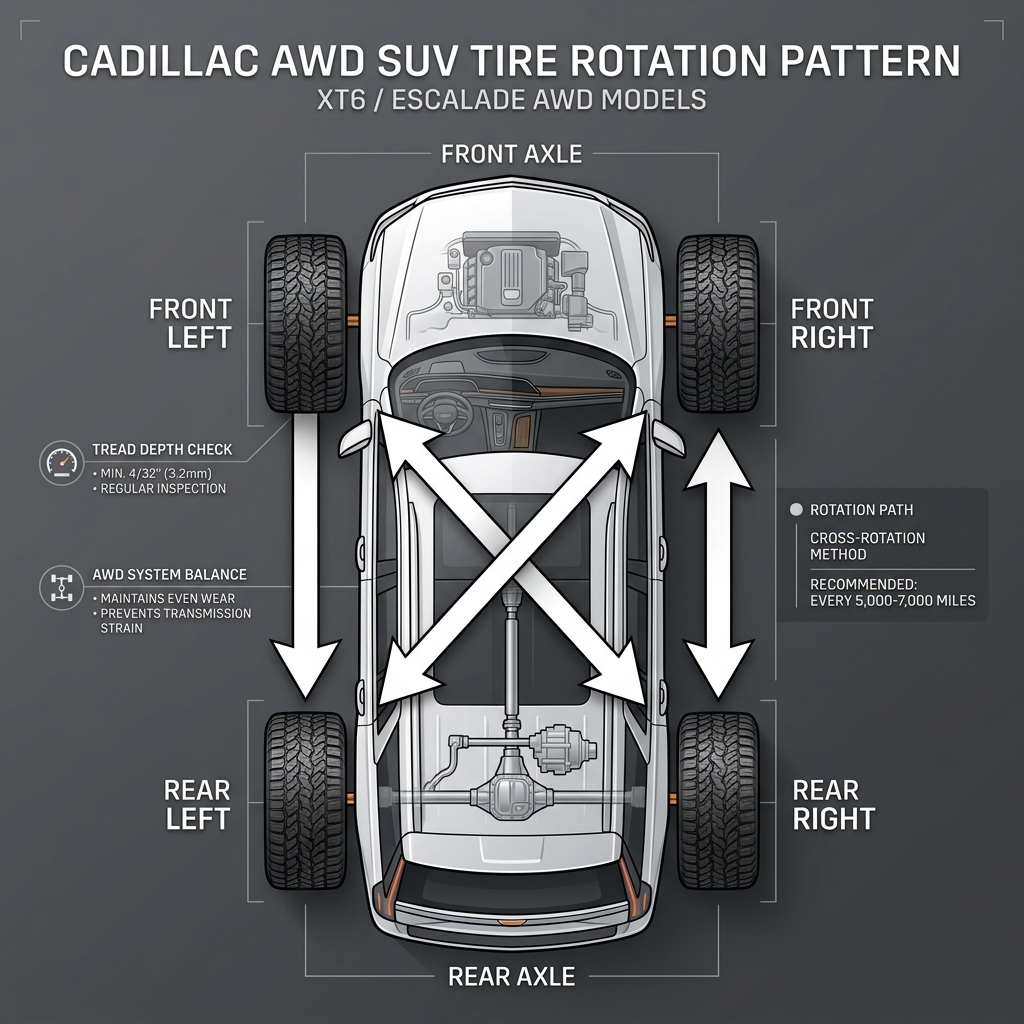
A common misconception among luxury SUV drivers is that All-Wheel Drive wears tires evenly at all four corners. In reality, front and rear tires experience vastly different forces. Front tires handle steering geometry, carry the majority of braking weight transfer, and bear the weight of heavy V-Series engines or dual-motor EV powertrains. Consequently, front tire shoulders typically wear down significantly faster than rear tires.
For Cadillac models equipped with active AWD or electronic limited-slip differentials (eLSD), General Motors recommends rotating tires every 5,000 to 7,500 miles(or during every oil change service). Regular rotations balance tread wear across all four positions, extending total tire lifespan and maintaining identical tire rolling diameters. If you're currently shopping for a pre-owned luxury vehicle, take a moment to Browse Used Inventory to inspect well-maintained AWD options.
Understanding AWD Transfer Case Strain Caused by Uneven Tire Diameter
Neglecting tire rotations on an AWD vehicle doesn't just shorten tire lifespan—it actively threatens expensive drivetrain components. Advanced Cadillac AWD systems, such as the twin-clutch rear axle system in the XT5 and XT6 or the Autotrac transfer case in the Escalade, rely on precise mathematical ratios between wheel speeds. These systems continually monitor sensors at all four wheels to detect loss of traction in milliseconds.
If tire wear becomes severely uneven—for example, if front tires are worn to 3/32" while rear tires remain at 7/32"—the physical rolling circumference of the front wheels becomes measurably smaller than the rear. A 4/32" difference in tread depth translates to over a half-inch difference in overall tire circumference. As you drive down I-80, the front tires must rotate faster than the rear tires just to keep pace.
This continuous difference in rotational speed tricks the vehicle’s StabiliTrak computer into sensing ongoing wheel slip. The internal clutches inside the transfer case or rear differential remain constantly engaged to compensate, building excessive internal heat and friction. Over time, driving with an uneven tire tread variance greater than 2/32" across tires can cause premature fluid breakdown, clutch pack glazing, and catastrophic transfer case damage.
How Joliet’s Fall Temperature Drop Affects Cadillac SUV Tire Pressure
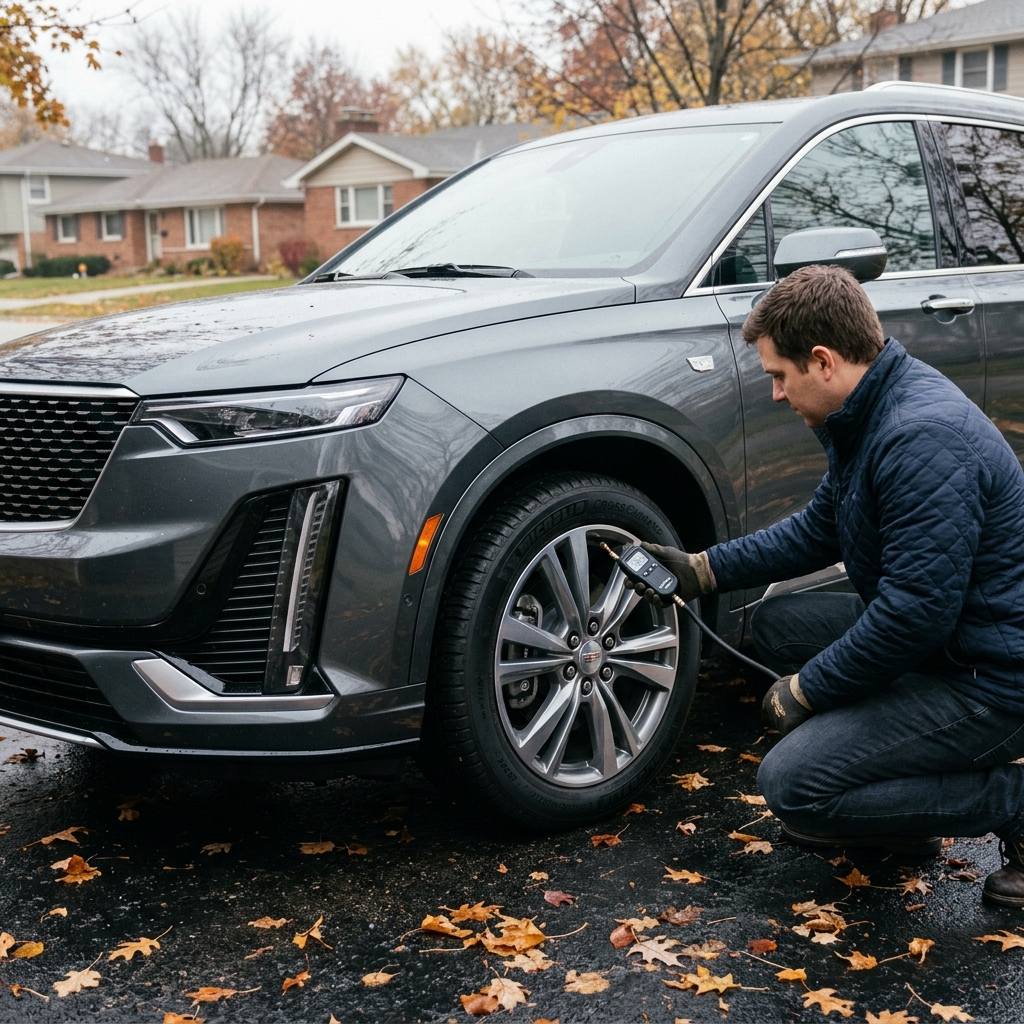
As autumn transitions into winter in Will County, sudden ambient temperature drops directly impact tire pressure. According to fundamental thermodynamic principles, air pressure inside a sealed tire decreases by approximately 1 PSI for every 10°F drop in outdoor temperature.
In early October, daytime highs in Joliet often hover around 68°F, but nighttime temperatures can plummet to 38°F by early November. That 30-degree swing results in an automatic loss of 3 to 4 PSI across all four tires. An under-inflated tire sags along its sidewalls, concentrating vehicle weight on the outer shoulders while causing the center tread to bow inward away from the pavement.
Cold Inflation Checking Routine: Monitoring TPMS vs Manual Pressure Gauges
1. Understand Cold PSI
Always measure tire pressure before driving or at least three hours after the vehicle has been parked. Driving heats up the air inside the tire, artificial inflating pressure readings by 3 to 5 PSI.
2. Reference Door Placard
Never rely on the maximum PSI printed on the tire sidewall. Always inflate to the recommended Cold Tire Pressure specified on the yellow-and-white sticker located inside the driver's door jamb.
3. Calibrate TPMS
Your Cadillac Tire Pressure Monitoring System (TPMS) offers real-time digital readouts. Check your instrument cluster monthly and recalibrate sensors after tire replacement. Need fresh sensors or factory accessories? You can Order Genuine Cadillac Parts directly online.
Choosing the Right All-Season or Winter Tire Compound for Plainfield Commuters
Selecting the proper tire compound comes down to your annual mileage, commute habits, and driving conditions. Standard M+S (Mud and Snow) All-Season tires are engineered for year-round durability, but their tread rubber begins stiffening when ambient temperatures drop below 45°F. Once frozen, hardened tread blocks lose micro-grip on wet or frosty pavement.
For superior winter performance without seasonal tire swaps, 3-Peak Mountain Snowflake (3PMSF) All-Weather tires feature advanced silica compounds that remain flexible in sub-zero weather while maintaining tread life in summer heat. Alternatively, drivers taking frequent winter highway trips through northern Illinois may prefer dedicated winter tires (such as Michelin X-Ice or Bridgestone Blizzak) mounted on a separate set of factory alloy wheels.
Stopping Distances on Wet and Icy Roads: Real-World Cadillac SUV Performance Data
To illustrate the real-world impact of tread depth decay, empirical braking tests performed on wet and slush-covered surfaces illustrate how dramatically stopping distances lengthen as tires wear down. Consider a typical 5,000-pound luxury crossover traveling at standard highway speeds:
|
Tread Depth Level
|
Wet Braking Distance (60-0 mph)
|
Slush Braking Distance (40-0 mph)
|
Hydroplaning Onset Speed
|
|
6/32 inch (Like-New)
|
145 Feet
|
82 Feet
|
58+ MPH
|
|
4/32 inch (Recommended Fall Limit)
|
170 Feet (+25 ft)
|
105 Feet (+23 ft)
|
48 MPH
|
|
2/32 inch (Legal Minimum Hazard)
|
205 Feet (+60 ft)
|
140 Feet (+58 ft)
|
39 MPH
|
As shown in the performance data above, driving on 2/32" tread adds 60 additional feet of stopping distance on wet roads compared to like-new tires—more than three full car lengths. Replacing worn tires at 4/32" provides the critical margin of safety needed to prevent rear-end collisions during sudden slowdowns on I-55.
Pre-Winter Cadillac Tire and Wheel Care Checklist
1. Four-Wheel Alignment
Potholes along Jefferson Street can knock your wheel alignment out of specification. Precision computer alignment prevents uneven shoulder wear and maintains straight-line tracking on slick roads.
2. Road-Force Balancing
High-speed highway vibration often stems from subtle wheel imbalances. Road-force balancing simulates actual road weight to eliminate vibration and ensure smooth luxury ride quality.
3. Spare & Kit Check
Verify spare tire pressure (typically 60 PSI cold) or inspect the shelf-life date on your emergency tire sealant kit before winter arrives. Ready for autumn maintenance? Schedule Your Service Today.
Hawk Cadillac Tire Center Services and Seasonal Price Match Guarantee
At Hawk Cadillac in Joliet, our GM Factory-Trained Certified Technicians understand the exacting engineering standards of your Cadillac vehicle. We stock GM Original Equipment (OE) tires specifically tuned for Cadillac suspension characteristics, noise reduction specs, and AWD load ratings.
Take advantage of our 30-Day Tire Price Match Guarantee alongside major manufacturer rebates on premium brands including Michelin, Goodyear, Continental, and Bridgestone. Looking to upgrade your vehicle while replacing tires? Value Your Trade online or Get Pre-Approved for Financing in minutes.
Schedule Your Autumn Cadillac SUV Tire and AWD Inspection at Hawk Cadillac in Joliet
Don't wait for the first severe autumn storm or freeze to discover your tire tread has worn past safe limits. Protect your family, your vehicle, and your Cadillac AWD system by scheduling a comprehensive autumn tire inspection at Hawk Cadillac today.