Cadillac SUV Tire Tread Depth Thresholds for Wet Joliet Autumns and Early Snow
When autumn arrives across Will County, driving conditions around Joliet, Plainfield, and Naperville shift rapidly. Heavy October rainstorms, fallen damp leaf matrices, and sudden November flash freezes create treacherous road surfaces along major corridors like I-55, I-80, and Route 59. For drivers of luxury crossover vehicles and full-size SUVs—such as the Cadillac XT4, XT5, XT6, and Escalade—maintaining optimal tire contact is paramount to safety, ride refined comfort, and mechanical drivetrain longevity.
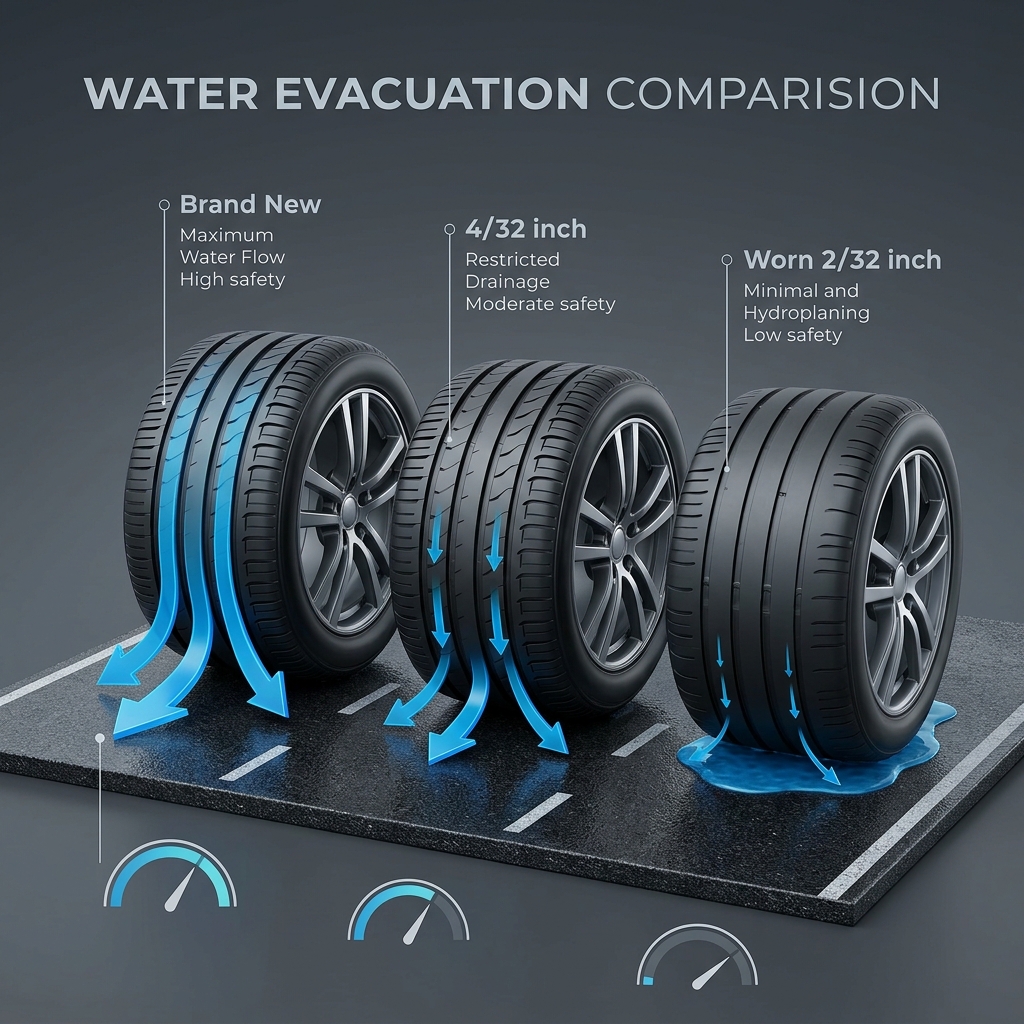
While the legal minimum tread depth across Illinois is 2/32 of an inch, waiting until your tires reach this wear bar state before winter is a dangerous gamble. Expert automotive engineers and tire manufacturers strongly advise that luxury SUV drivers replace all-season tires when tread depth reaches 4/32 of an inch before fall rains and early snowfall begin. Between 5/32 and 4/32 of an inch, a tire's capacity to evacuate standing water degrades dramatically. For heavier vehicles like the Cadillac Escalade or XT6, reduced tread depth dramatically increases stopping distances and neutralizes the active safety benefits of advanced All-Wheel Drive (AWD) systems.
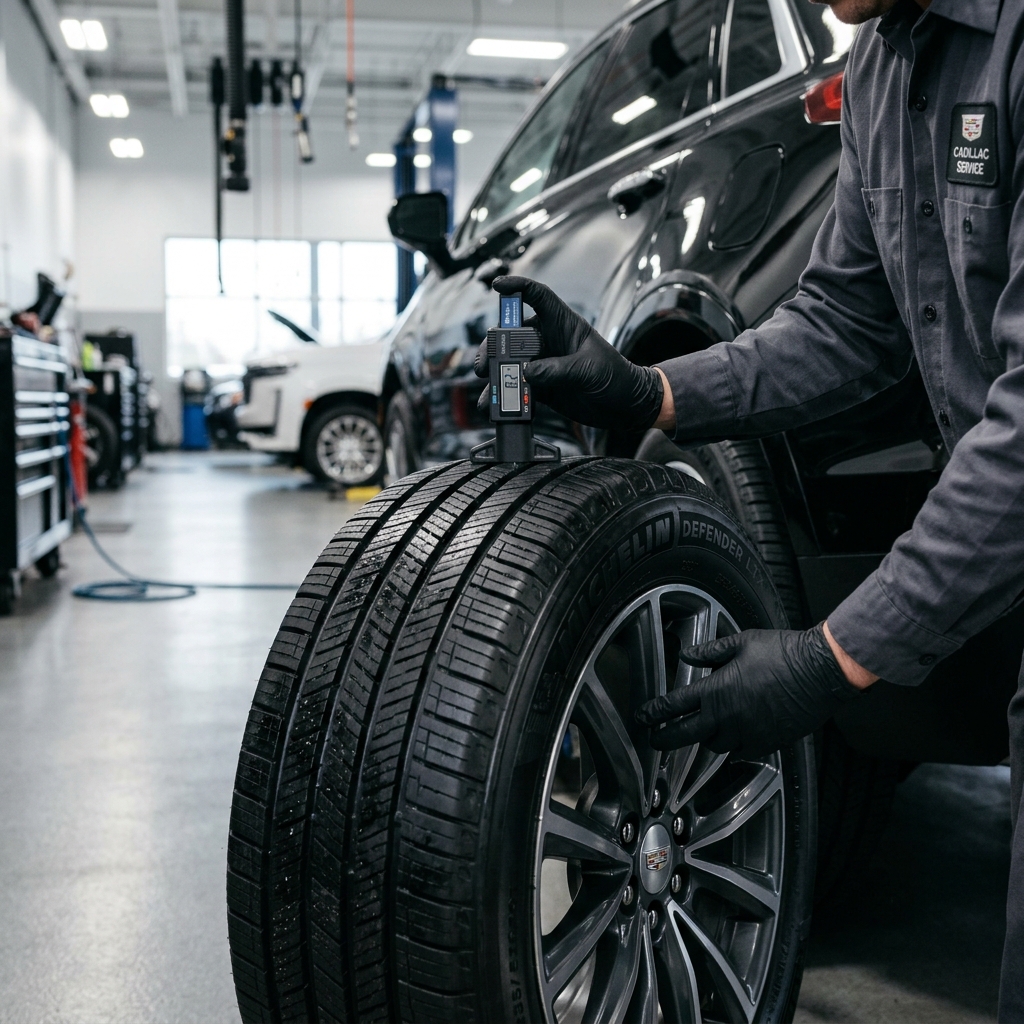
At Hawk Cadillac in Joliet, our certified service team evaluates tire health holistically. In this comprehensive guide, we examine the physics of hydroplaning, the critical relationship between tire pressure and AWD torque management, and actionable steps to prepare your Cadillac luxury vehicle for Chicagoland's challenging autumn weather.
Why 2/32 Inches Is Too Late for Chicagoland Fall Rain and Early Winter Slush
The standard legal threshold of 2/32 of an inch was originally established to prevent catastrophic tire blowouts, not to guarantee wet-weather traction. Tread grooves act as microscopic hydraulic pumps. As a tire rotates over wet pavement, these circumferential grooves and lateral sipes channel water away from the contact patch, allowing rubber to make direct contact with the road surface. When tread wears down to 4/32 of an inch, the volume of water the grooves can channel per second drops by over 50%. At 2/32 of an inch, the tire effectively becomes a smooth surface when encountering pooled standing water at highway speeds along I-55 or Route 59. Water builds up underneath the tire tread, forming a wedge that lifts the vehicle off the asphalt—a phenomenon known as hydroplaning.
Furthermore, fall driving presents unique road hazards like decaying wet leaf matrices ("leaf slime"). Wet leaves create a slick layer with a friction coefficient comparable to packed ice. Heavy luxury vehicles like the Escalade (curb weight exceeding 5,600 lbs) require maximum physical rubber bite to cut through leaf slurry and engage the pavement beneath. Relying on 2/32-inch tread depth in these conditions drastically increases emergency stopping distances and limits lateral cornering control.
How to Measure Your Cadillac SUV Tire Tread Depth Accurately at Home
Accurate tread depth assessment is simple to perform in your driveway. Because wide high-performance tires on modern Cadillac SUVs often wear unevenly across their surface, precise evaluation across multiple points is critical.
1. Digital Depth Gauge
The most precise method involves an inexpensive digital tread depth gauge. Insert the probe into the deepest main groove, press the base flat against the tread block, and read the display in 32nds of an inch. Zero the gauge on a flat surface before taking measurements across every tire.
2. Washington Quarter Test
While the penny test checks for 2/32", the quarter test verifies the crucial 4/32" threshold. Insert a Washington quarter upside-down into the tread groove. If the top of Washington's head is covered by the tread block, you have at least 4/32" remaining. If the top of his head is visible, schedule replacement immediately.
3. Multi-Zone Inspection
Luxury SUVs feature wide contact patches (e.g., 275/50R22 on Escalade or 235/55R20 on XT5). Always measure three distinct zones per tire: inner shoulder, center, and outer shoulder. Wear is governed by the shallowest reading found across any zone.
How Joliet’s Fall Temperature Drop Affects Cadillac SUV Tire Pressure and AWD Safety
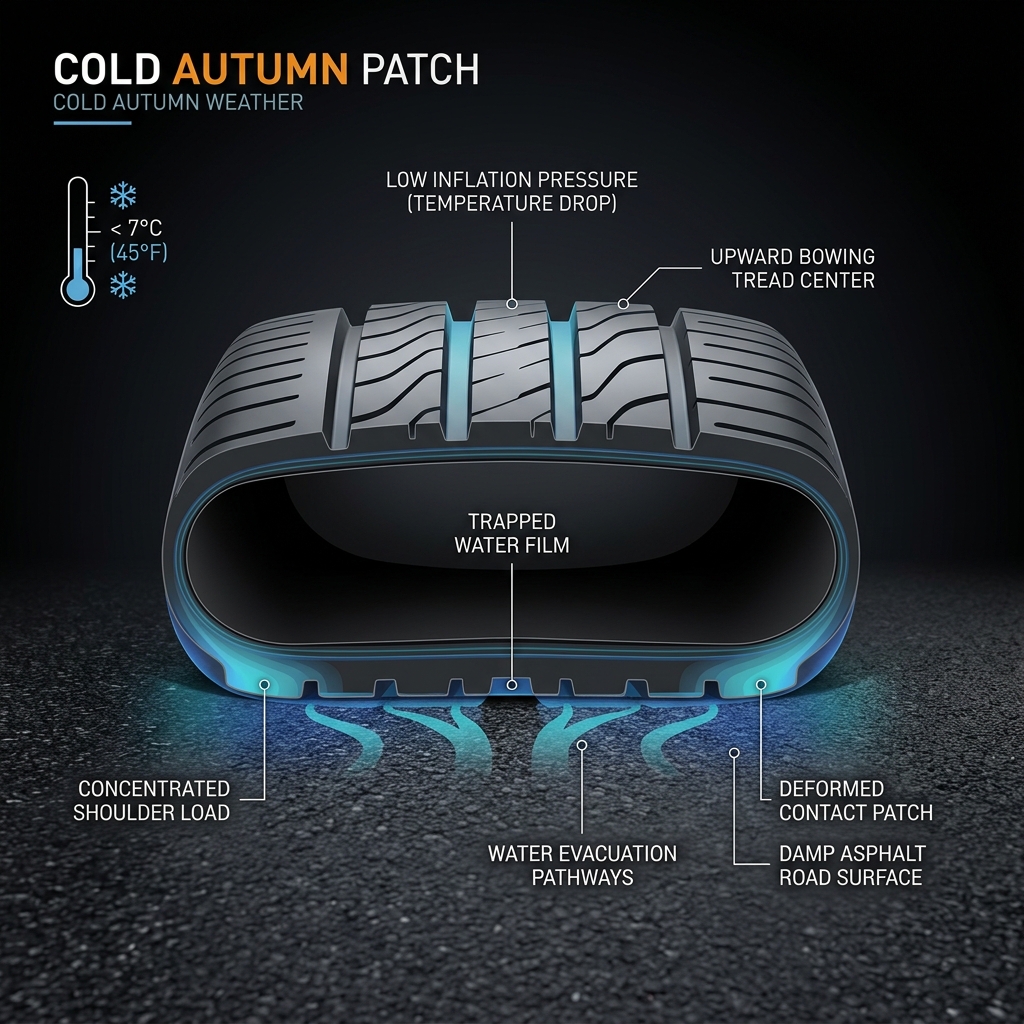
As autumn transitions to late fall in northern Illinois, rapid temperature swings occur regularly. Ambient temperature directly dictates internal tire pressure according to Gay-Lussac's Law of thermodynamics: for every 10°F drop in ambient temperature, tire pressure decreases by approximately 1 PSI (pound per square inch). A temperature drop from a 75°F September afternoon to a 35°F crisp October morning causes an unadjusted tire to lose 4 PSI. An underinflated tire deforms its contact patch, causing the center of the tread to bow upward away from the road while placing excessive force on the outer shoulders. This deformation seriously hinders the tire's ability to shed standing rain.
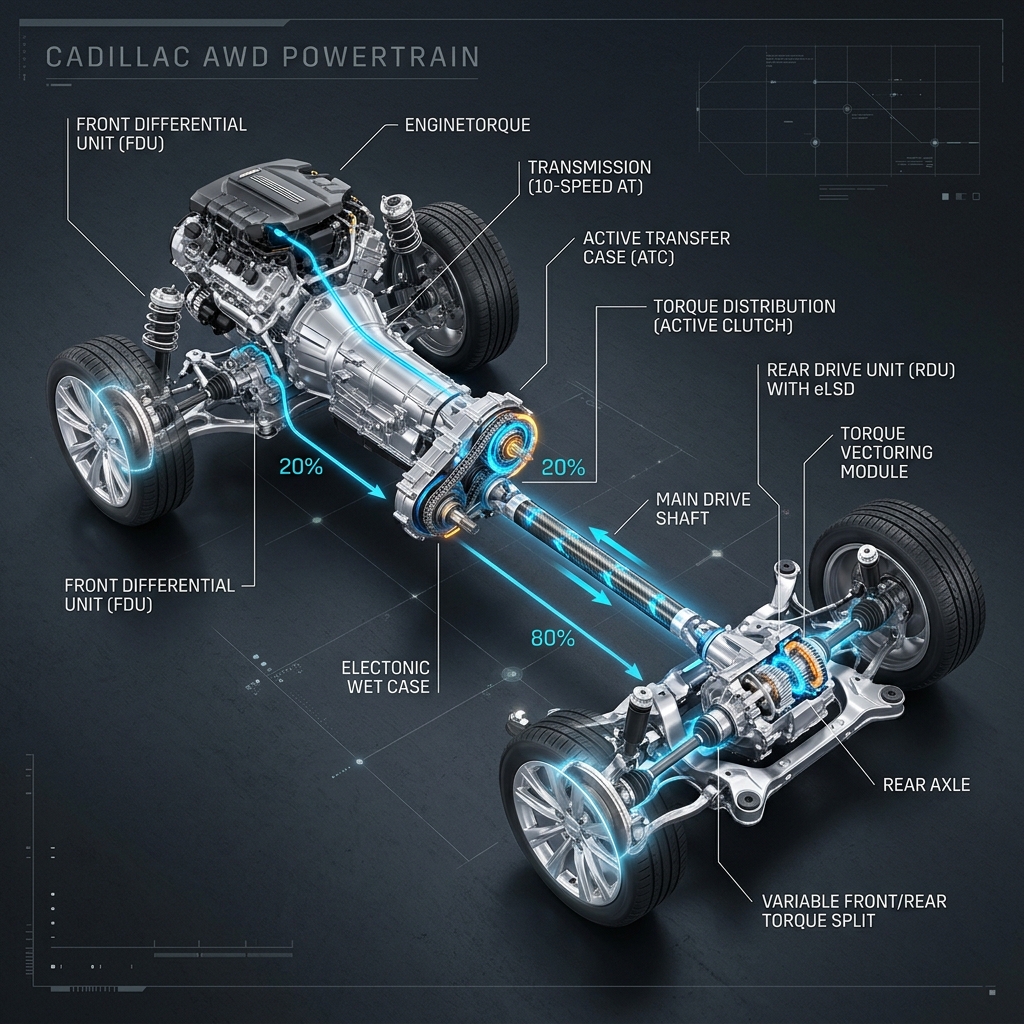
For Cadillac models equipped with advanced Twin-Clutch AWD or electronic torque-vectoring systems (such as the XT5 Sport or XT6), uneven tire pressure across corners alters individual wheel rolling circumferences. This misleads wheel-speed sensors, forcing the AWD computer to detect artificial slippage. The transfer case and rear drive unit may continuously engage and disengage, causing thermal stress and premature component wear.
Chicagoland Autumn Driving Prep: Tire Tread and All-Wheel Drive Maintenance for Cadillac SUVs
Preparing your luxury crossover or SUV for autumn involves more than simply checking tread depth. A holistic vehicle readiness protocol integrates tire inspection, wheel balancing, alignment verification, and active safety sensor calibration.
Cadillac StabiliTrak® stability control and Driver Assist packages (including Automatic Emergency Braking and Adaptive Cruise Control) rely on calculated traction coefficients. When tires possess adequate tread depth (4/32" or greater) and correct cold inflation pressures, sensor algorithms accurately predict vehicle trajectory during emergency maneuvers on wet Plainfield roadways or slick Naperville intersections. Conversely, worn tires create a mismatch between vehicle telemetry and actual physics, delaying electronic stability interventions.
To maintain optimal harmony between mechanical hardware and electronic software, ensure that wheel balancing is verified during every autumn tire service. Even minor dynamic imbalance generates subtle vertical oscillations that unevenly wear tread blocks, rapidly destroying water-evacuation channels before snow arrives.
How Often to Rotate Tires on an AWD Cadillac Escalade or XT Crossover to Protect Transfer Cases
Regular tire rotation is critical for all vehicles, but it is vital for full-time and active All-Wheel Drive luxury vehicles. Front tires encounter significantly higher lateral friction loads during steering and support the heavy forward engine bias, causing them to wear faster than rear tires. On an AWD Cadillac Escalade or XT series crossover, a tread depth variance greater than 2/32 of an inch between axles creates a noticeable difference in overall rolling diameter. For example, a new tire at 10/32" has a larger circumference than a worn tire at 6/32". When fitted to the same AWD drivetrain, the front and rear axles rotate at slightly different speeds even when driving perfectly straight.
This rotation speed discrepancy forces internal transfer case clutches and center differential gears to work constantly, causing excessive friction, fluid oxidation, and thermal breakdown. To protect these sophisticated drivetrain components, tire rotation must be performed every 5,000 to 7,500 miles (or during every scheduled oil change).
All-Season vs. Weather-Active Tires for Plainfield and Naperville Autumn Commutes
Understanding tire compound science helps Cadillac owners choose the ideal replacement tire for Chicagoland's harsh seasonal changes.
Standard M+S All-Season
Factory Mud & Snow (M+S) rated tires deliver quiet ride comfort and low rolling resistance in warm weather. However, their synthetic rubber compound begins stiffening ("glass transition threshold") when temperatures drop below 45°F, significantly reducing grip on wet cold pavement.
3PMSF Weather-Active Tires
Modern "All-Weather" or Weather-Active tires feature the 3-Peak Mountain Snowflake (3PMSF) emblem. Formulated with high silica content, their rubber remains pliable in sub-freezing conditions while maintaining structural integrity during warm summer highway cruising.
Ideal Local Choice
For suburban commuters traversing I-55 daily, 3PMSF-rated all-weather tires provide superior cold-wet braking, excellent slush evacuation, and elimination of biannual seasonal tire changeovers required by dedicated winter tires.
Model-Specific Tire Requirements: Escalade, XT6, XT5, and XT4 Load Indices and Tread Ratings
Every Cadillac luxury SUV features precise chassis tuning and suspension geometry engineered around specific Original Equipment (OE) tire specifications. Installing replacement tires with improper load index or speed ratings degrades ride quality, increases cabin noise, and accelerates tread shoulder deterioration.
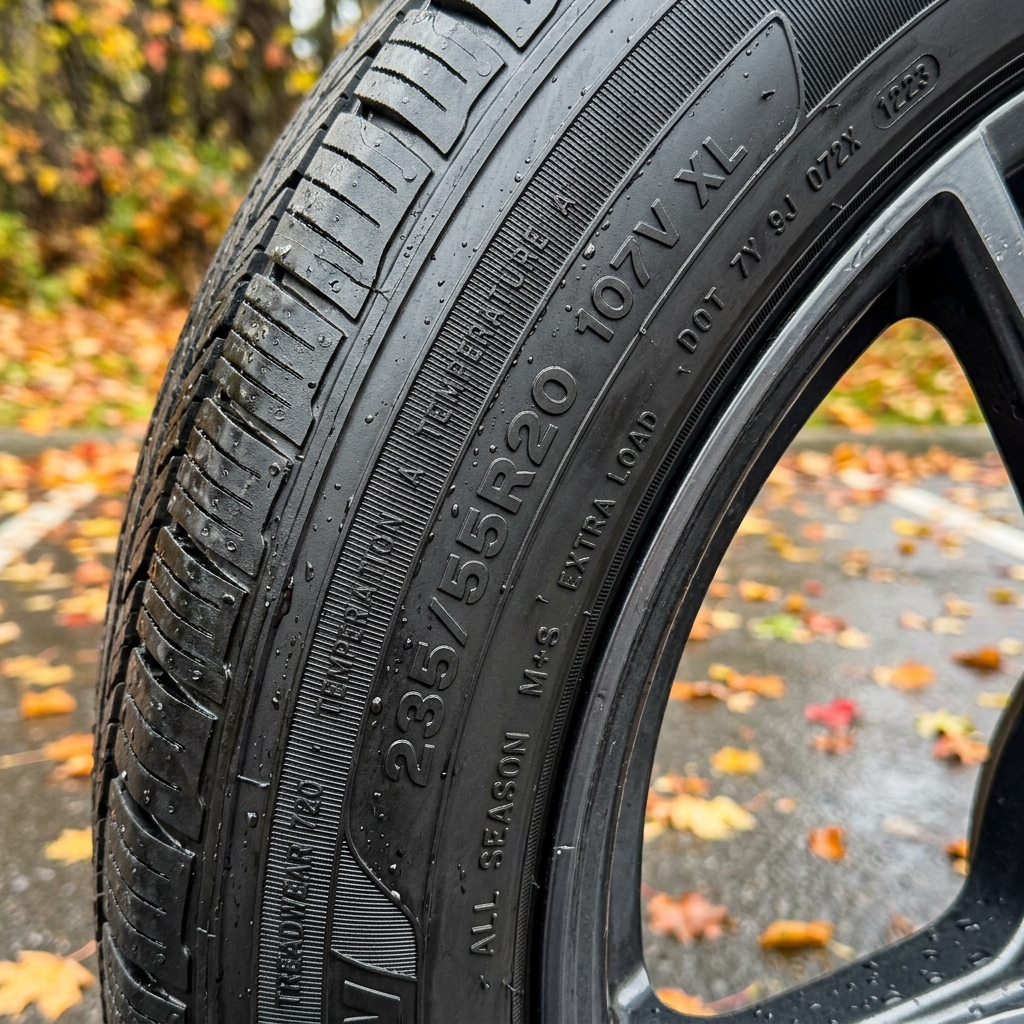
• Cadillac Escalade / Escalade ESV: Requires heavy-duty extra load ratings (e.g., 275/50R22 114H or 115H XL). Given curb weights up to 6,200 lbs plus towing capacities, tire sidewalls require reinforced plies to limit roll during high-speed cornering on rain-slick curves. • Cadillac XT6: Typically equipped with 235/55R20 107V extra-load tires. Designed for three-row passenger safety, requiring rigid shoulder blocks for confident braking. • Cadillac XT5: Uses 235/65R18 106H or 235/55R20 107V fitments. Requires balanced dampening compound properties to match Continuous Damping Control (CDC) suspension setups. • Cadillac XT4: Utilizes 235/60R18 103H or 245/45R20 99H tires, prioritizing agile steering feedback and quick hydraulic water dispersion.
Real-World Stopping Distances: Wet Asphalt, Leaf Slime, and Early Snow Performance
To understand the direct connection between tread depth and driver safety, consider comparative stopping distance data collected from tests involving luxury SUVs decelerating from 60 mph to a complete stop across wet asphalt, wet leaf residue, and light slush.
|
Tread Depth Condition
|
Wet Asphalt (60-0 mph)
|
Wet Leaf Slime (45-0 mph)
|
Early Slush / Light Snow (35-0 mph)
|
|
New Tread (10/32")
|
165 feet
|
110 feet
|
85 feet
|
|
Recommended Threshold (4/32")
|
205 feet (+40 ft)
|
142 feet (+32 ft)
|
118 feet (+33 ft)
|
|
Legal Minimum (2/32")
|
280 feet (+115 ft)
|
210 feet (+100 ft)
|
175 feet (+90 ft)
|
As shown above, stopping on wet asphalt with tires at the legal minimum threshold of 2/32" requires an additional 115 feet compared to new tires—a distance equivalent to roughly six full car lengths. Replacing worn tires at 4/32" preserves crucial stopping margins, preventing potential front-end collisions during sudden slowdowns along Jefferson Street or I-80.
Identifying Uneven Tread Wear Patterns Caused by Will County Road Conditions
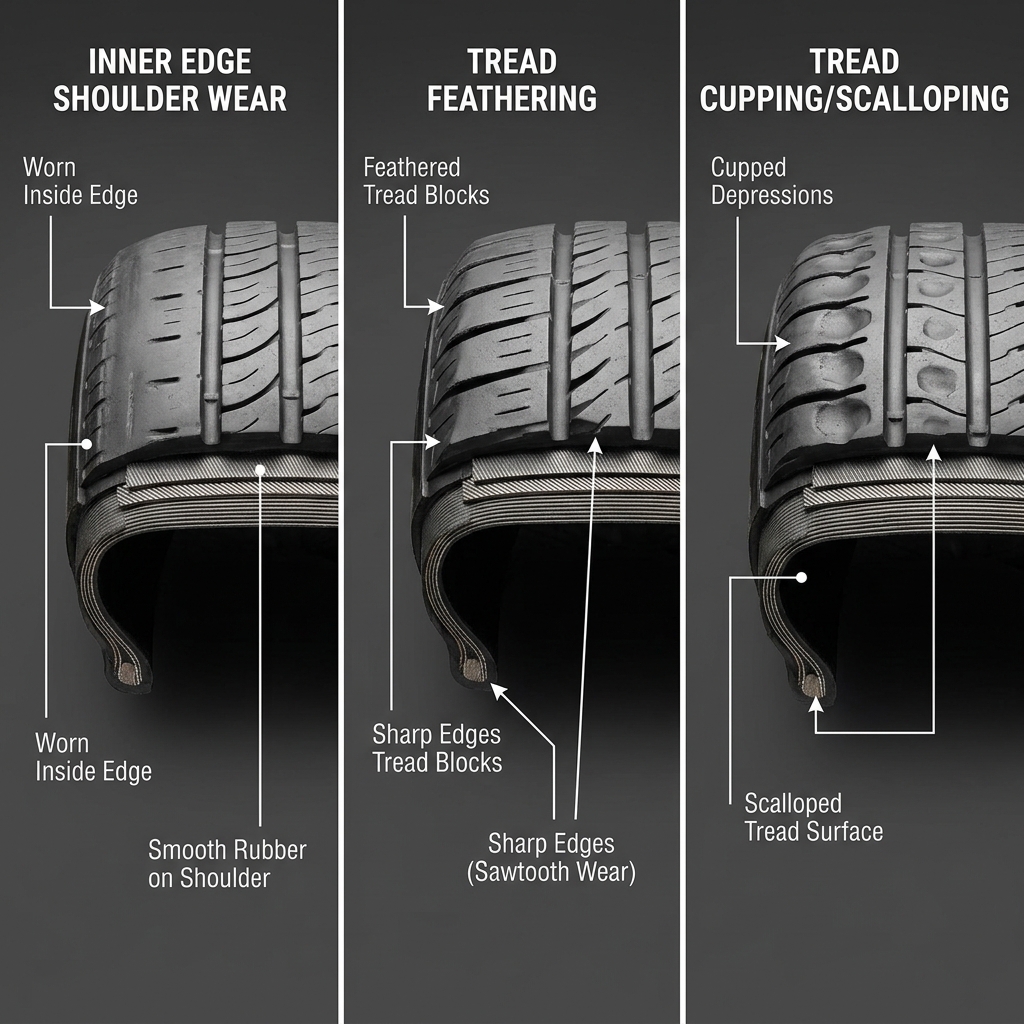
Summer construction zones and severe winter freeze-thaw cycles create challenging pothole conditions across Will County roads. Impacting potholes or curb edges at speed alters precision wheel alignment angles (camber, caster, and toe), leading to distinct irregular tread wear patterns:
• Inner-Edge Shoulder Wear: Excessive negative camber causes the innermost rib of the tread to wear down to steel cords while outer tread appears normal. Common after hitting sharp pothole edges. • Tread Feathering: Smooth on one side and sharp on the other across individual tread blocks. Caused by incorrect toe alignment, dragging the tire sideways across pavement. • Cupping or Scalloping: Diagonal scoops or depressions carved out of the tread edge. Indicates worn shocks, struts, or out-of-balance wheel assemblies failing to hold the tire firmly against the road surface.
Pre-Winter Cadillac Tire and AWD Inspection Checklist for Local Drivers
Use this 5-point checklist before winter weather hits Chicagoland:
1. Tread Depth Check
Verify all four tires have at least 4/32" tread depth across inner, center, and outer grooves using a depth gauge or quarter test.
2. Cold Pressure Check
Adjust cold inflation pressures to match the vehicle door jamb placard specs on crisp autumn mornings.
3. 5k Mile Rotation
Rotate tires every 5,000–7,500 miles to keep front-to-rear tread depth variance within 2/32" and protect your AWD system.
4. Alignment Check
Schedule precision digital alignment if steering pulls or uneven shoulder wear is observed.
5. Spare Tire Check
Inspect spare tire pressure (typically 60 PSI for compact spares) or verify emergency sealant tire inflator kit expiration dates.
Schedule Your Cadillac Autumn Tire Service and Inspection at Hawk Cadillac in Joliet
Don't wait for the first freezing rain or early Chicagoland snowstorm to test your tire tread depth. Protecting your family, passengers, and luxury Cadillac SUV requires proactive tire care before cold weather sets in.
The Factory-Certified Service Center at Hawk Cadillac in Joliet is equipped with state-of-the-art tire diagnostic equipment, laser wheel alignment systems, and direct access to OEM-approved Michelin, Continental, Goodyear, and Bridgestone tires engineered specifically for your XT4, XT5, XT6, or Escalade.