What Amperage Level Home Charger Is Needed for Full Winter Pre-Conditioning Support?
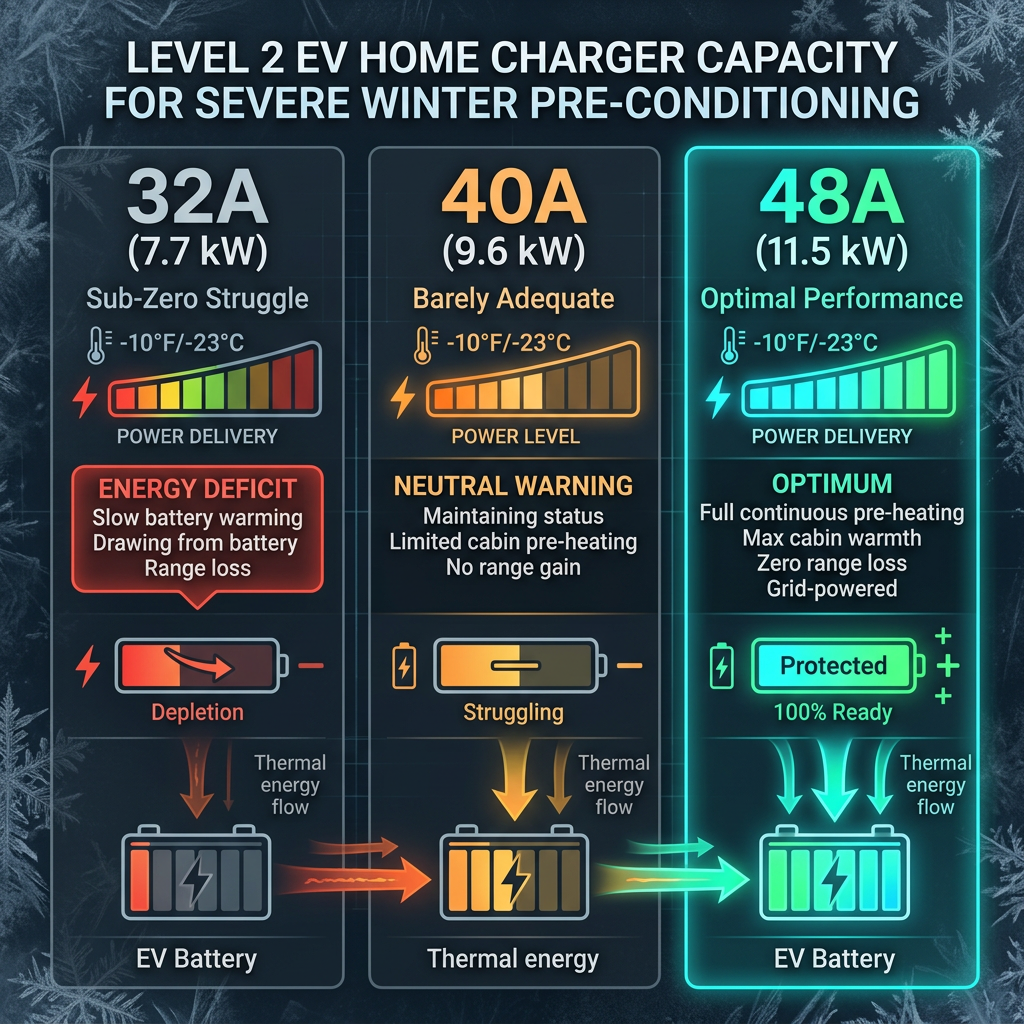
To achieve full winter pre-conditioning without draining a single percentage point from your high-voltage battery, a hardwired 48-amp Level 2 EV charger on a dedicated 60-amp circuit (delivering 11.5 kW of continuous power) is strongly recommended. When severe sub-zero cold strikes northern Illinois, your electric vehicle must generate substantial thermal energy—often requiring between 7 kW and 10 kW simultaneously—to heat the massive Ultium battery pack and rapidly warm the passenger cabin. Lower-amperage home charging setups, such as standard 32-amp (7.7 kW) or 40-amp (9.6 kW) units, routinely face power deficits during extreme thermal demand. When total pre-conditioning draw exceeds what the charger can supply, the vehicle's energy management software is forced to draw supplementary electricity directly from the high-voltage battery. Consequently, drivers who unplug after pre-conditioning on a 32-amp charger in sub-zero weather may find their state of charge has dropped by 3% to 8% before even pulling out of the driveway.
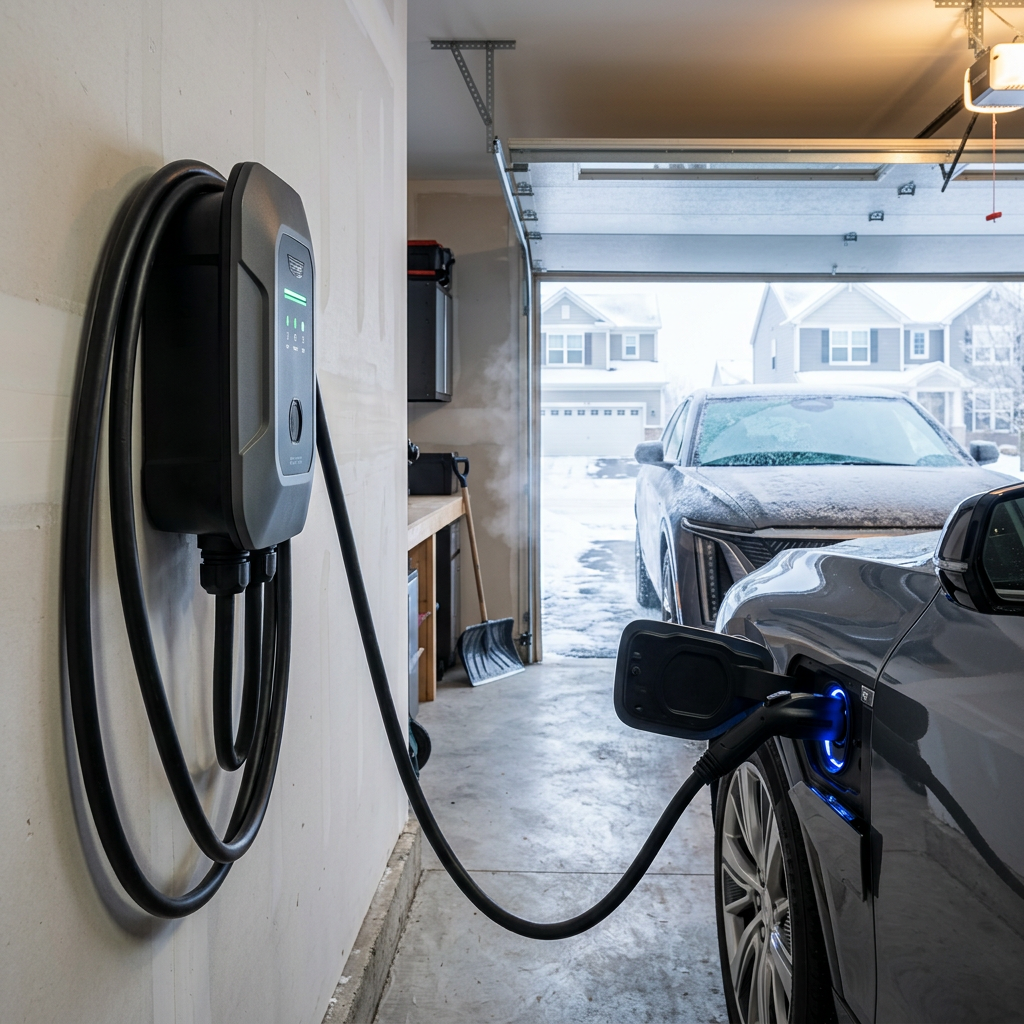
Understanding the electrical physics behind winter pre-conditioning is essential for luxury EV owners across Joliet, Plainfield, and Naperville. In peak summer or mild fall weather, maintaining battery temperature requires minimal grid power. However, sub-zero ambient temperatures dramatically alter electrochemical dynamics. Lithium-ion chemistry stiffens in severe cold, increasing internal impedance and temporarily restricting both charge acceptance and power discharge rates. By installing a hardwired 48-amp charger powered by a dedicated 60-amp circuit breaker, your home electrical system becomes a high-output thermal power station. It continuously supplies full 11.5 kW power directly to the onboard thermal management unit. This allows your Cadillac EV to bring cell temperatures up to their optimal operating range while simultaneously creating a plush, heated cabin environment—all while leaving your battery at 100% target state of charge for maximum driving distance.
How Does Battery Pre-Conditioning Work on a Cadillac EV in Sub-Zero Winter Weather?
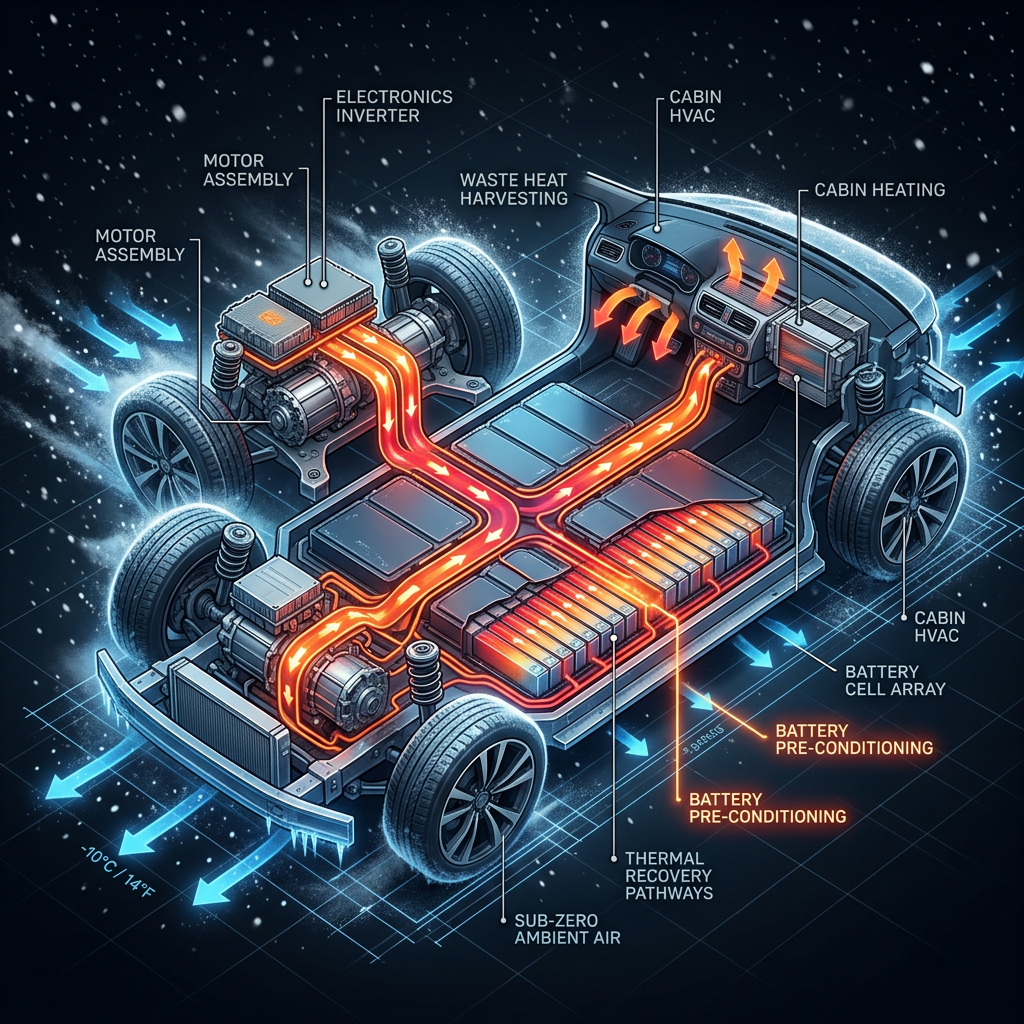
Battery pre-conditioning is a sophisticated thermal management process executed by GM's advanced Ultium EV platform. When ambient temperatures drop below freezing in northern Illinois, lithium-ion battery chemistry experiences reduced ion mobility within the liquid electrolyte. If you attempt to drive or DC fast-charge a cold-soaked battery, the vehicle must consume extra energy just to move ions, resulting in reduced efficiency and temporary power output restrictions. During pre-conditioning, high-capacity electric fluid heaters pump warm glycol-based coolant through dedicated thermal channels woven throughout the battery module matrix. This process gradually elevates cell temperature to the sweet spot between 65°F and 75°F (18°C to 24°C). Optimizing cell temperature before driving eliminates cold-start internal resistance, restores full regenerative braking power from the first mile, and prevents long-term metallic lithium plating on cell anodes.
Crucially, pre-conditioning on grid power preserves your EV's stored chemical energy. If an unconditioned EV is driven cold in zero-degree temperatures, the vehicle must siphon up to 10 kW of power directly from the battery while driving to warm up the battery loop and cabin air simultaneously. This causes steep range degradation within the first 15 minutes of travel. Pre-heating while plugged in shifts that heavy thermodynamic workload onto your home utility power. When you leave your driveway in Plainfield or Naperville, your battery is already thermally happy, the cabin is warm, and every kilowatt-hour stored in the vehicle pack remains intact for driving distance. Drivers who pre-condition consistently enjoy up to 25% more usable range during severe winter cold snaps.
Amperage Breakdown: Comparing 32-Amp, 40-Amp, and 48-Amp Level 2 Charging Speeds
32-Amp Level 2 (7.7 kW)
Circuit Breaker: 40-Amp Plug Type: NEMA 14-50 or Hardwired Continuous Power: 7.7 kW Miles Added / Hr:~20–25 miles Winter Pre-Conditioning Performance: Severe deficits during sub-zero cold snaps. When cabin climate and battery heater demand 9–10 kW combined, a 7.7 kW output falls short by 1.5–2.5 kW. The vehicle compensates by pulling the remaining energy directly from the battery pack, resulting in net range depletion before departure.
40-Amp Level 2 (9.6 kW)
Circuit Breaker: 50-Amp Plug Type: NEMA 14-50 Plug-In Continuous Power: 9.6 kW Miles Added / Hr:~28–32 miles Winter Pre-Conditioning Performance: Adequate for moderate cold (20°F to 32°F), but reaches absolute capacity when temperatures drop below zero. At 0°F with defrost set to max, a 9.6 kW supply leaves zero headroom for simultaneous high-rate charging or extreme thermal spikes.
48-Amp Level 2 (11.5 kW)
Circuit Breaker: 60-Amp Plug Type: Hardwired Connection Only Continuous Power: 11.5 kW Miles Added / Hr:~35–37 miles Winter Pre-Conditioning Performance: Ideal gold standard for Chicagoland winters. Easily delivers full 10 kW needed for dual cabin/battery pre-heating while keeping a 1.5 kW surplus to top off battery cells simultaneously.
|
Charger Output (Amps)
|
Required Breaker (Amps)
|
Power Output (kW)
|
Sub-Zero Thermal Deficit?
|
Pre-Conditioning Efficiency
|
|
12 Amp (Level 1)
|
15 Amp
|
1.4 kW
|
Extreme (-8.6 kW deficit)
|
Inadequate (Battery drains rapid)
|
|
32 Amp (Level 2)
|
40 Amp
|
7.7 kW
|
Moderate (-2.3 kW deficit)
|
Partial battery drain during defrost
|
|
40 Amp (Level 2)
|
50 Amp
|
9.6 kW
|
Minimal (-0.4 kW deficit)
|
Good, borderline in extreme freeze
|
|
48 Amp (Level 2)
|
60 Amp
|
11.5 kW
|
None (+1.5 kW surplus)
|
Optimal 100% Grid Powered
|
Preparing Your Cadillac EV for Chicagoland Sub-Zero Winters: Battery Pre-Conditioning & Range Care
Living in northern Illinois means preparing for dramatic temperature drops, icy lake-effect winds, and extended deep freezes. For luxury EV drivers across Plainfield, Naperville, and Joliet, proactive winter preparation is the key to an effortless ownership experience. Modern electric vehicles offer unprecedented comfort and instant cabin heating, but taking a few strategic steps before winter arrives ensures your vehicle performs at peak efficiency. First, optimize your home charging installation early in the autumn season. If you are currently using a standard 120V outlet or an entry-level 32A plug-in charger, upgrading to a hardwired 48A home unit will completely transform cold-weather convenience. Having 11.5 kW of continuous power ready in your garage eliminates cold-start delay and guarantees your vehicle is fully warmed and charged every single morning. Second, keep your vehicle plugged in whenever parked at home during winter months. Even when charging is complete, maintaining a grid connection allows the Ultium battery management system to execute automated background thermal maintenance. If ambient temperatures in an unheated garage plummet to single digits, the vehicle will draw tiny trickle currents from your wall power to prevent freezing stress on individual lithium-ion cells without draining battery range. Learn more about charging options or Order Genuine Cadillac Parts for official home chargers directly through Hawk Cadillac.
How Does Cadillac's Heat Recovery System Differ from Tesla's Octovalve Heat Pump?
Both Cadillac's Ultium Energy Recovery System and Tesla's Octovalve heat pump architecture represent significant leaps forward in EV thermodynamic efficiency compared to legacy resistive heaters. However, their engineering approaches differ markedly in multi-source energy harvesting and acoustic isolation. Tesla's Octovalve relies heavily on an intricate centralized 8-way manifold valve that routes refrigerant loops between the motor, inverter, battery, and cabin. While effective, Octovalve systems can grow noticeably loud during extreme cold starts as the heat pump compressor ramps up to ultra-high RPMs, causing cabin vibration and buzzing sound signatures. Cadillac's Ultium Energy Recovery System utilizes a holistic, multi-source waste heat scavenging network integrated directly into the chassis platform. It captures thermal energy from power electronics, high-output drive units, exterior ambient air, and even body heat released by cabin occupants. By capturing waste heat generated by heavy electronic switching inside the drive unit inverters, Cadillac reduces total HVAC electrical draw by up to 60% in freezing weather while operating with whispered, ultra-quiet interior acoustics fit for a true Cadillac luxury vehicle.
Should You Leave a Cadillac EV Plugged In Overnight During Extreme Cold Snaps?
Yes, absolutely. Leaving your Cadillac EV plugged into your home charger overnight during extreme cold weather is one of the most effective habits for long-term battery health and daily range maximization. When connected to home power, the vehicle's automated software enters a background maintenance protocol during deep freezes. If garage or outdoor ambient temperatures fall below freezing, the battery management computer wakes low-wattage heating elements to keep liquid coolant circulating around individual pouch cells. This prevents internal battery temperature from soaking down to dangerous, ultra-cold thresholds.
If an EV is left unplugged in sub-zero cold for several days, the vehicle must rely entirely on its own battery charge to run critical anti-freeze heating loops. Over a weekend cold snap, an unplugged EV can lose 5% to 12% of its total charge simply maintaining minimal safe battery temperature. By staying plugged into a 48-amp charger, 100% of this background thermal preservation draws clean utility power. Furthermore, when your programmed morning departure schedule arrives, the charger can immediately deliver max 11.5 kW output without waiting for battery wake-up sequences. If you have any questions about daily charging limits or seasonal maintenance, Call us at (815) 600-7027 to consult with our certified EV specialists.
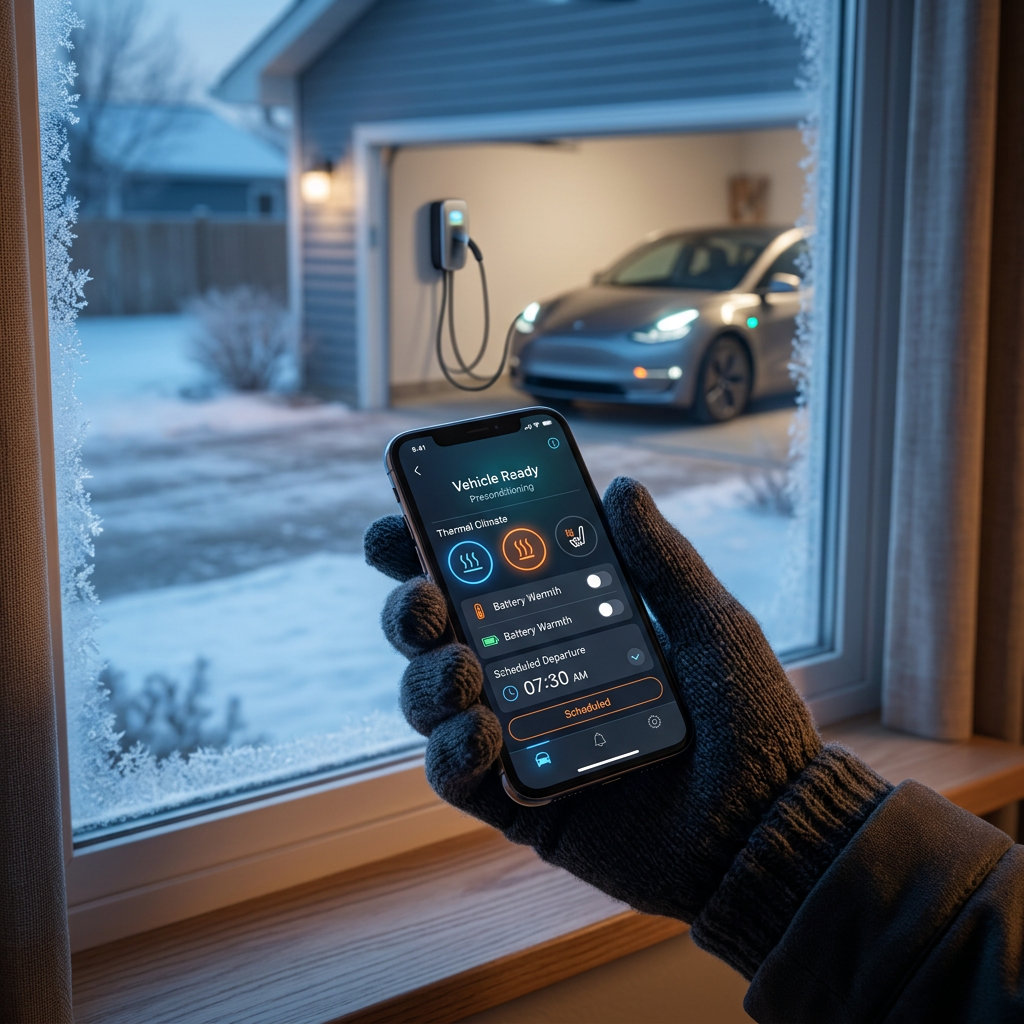
How Do You Schedule Battery Pre-Conditioning Using the myCadillac Mobile App?
Step 1: Set Departure Schedule
Open the myCadillac app on your smartphone, tap the Vehicle Status tab, and select Charge & Thermal Schedules. Choose your routine departure times (e.g., 7:30 AM Monday through Friday). Setting a fixed schedule allows the vehicle to calculate exactly when to initiate battery pre-heating based on real-time ambient temperatures.
Step 2: Customize Climate
Under Climate Controls inside the myCadillac app, toggle on Auto Heated Seats & Steering Wheel alongside cabin temperature pre-sets. Setting target cabin temperature to 70°F ensures defrost systems clear windshield ice while heating surfaces warm the touchpoints you use most.
Step 3: Plug In & Automate
Connect your 48A home charger before retiring for the night. The vehicle will manage overnight charging according to your utility rate schedule, then automatically execute the thermal pre-conditioning cycle 30 to 45 minutes prior to your scheduled departure time.
Does Using Heated Seats and Steering Wheel Save More Range Than Running the Cabin Heater?
Yes, using conductive surface heating (heated seats and heated steering wheel) consumes significantly less energy than forced-air cabin climate control, saving substantial driving range. To understand why, compare the energy draw of both systems: • Heated Seats & Steering Wheel: Conductive heat transfers energy directly to your body contact points. A heated driver seat draws roughly 40 to 60 watts, while a heated steering wheel consumes around 30 to 40 watts. Total energy draw is under 100 watts (0.1 kW). • Forced-Air HVAC Cabin Heater: Warming hundreds of cubic feet of cold ambient air inside the passenger compartment requires resistive heating elements or high-output heat pump compression. In sub-zero weather, cabin forced-air HVAC draws between 3,000 watts to 6,000 watts (3.0 kW to 6.0 kW) continuously. Running cabin HVAC at high temperatures consumes up to 60 times more power per hour than surface heaters. By pre-conditioning your vehicle while plugged into grid power, you raise the cabin air temperature to a baseline level before unplugging. Once on the road across I-55 or I-80, setting forced-air climate control to a modest 66°F and relying primarily on heated seats and steering wheel can recover 15 to 30 miles of real-world driving range per trip. To explore new high-efficiency electric models equipped with intelligent climate management, Browse New Inventory at Hawk Cadillac.
How Much Does an Official Winter Wheel and Tire Package Cost for a Cadillac EV?
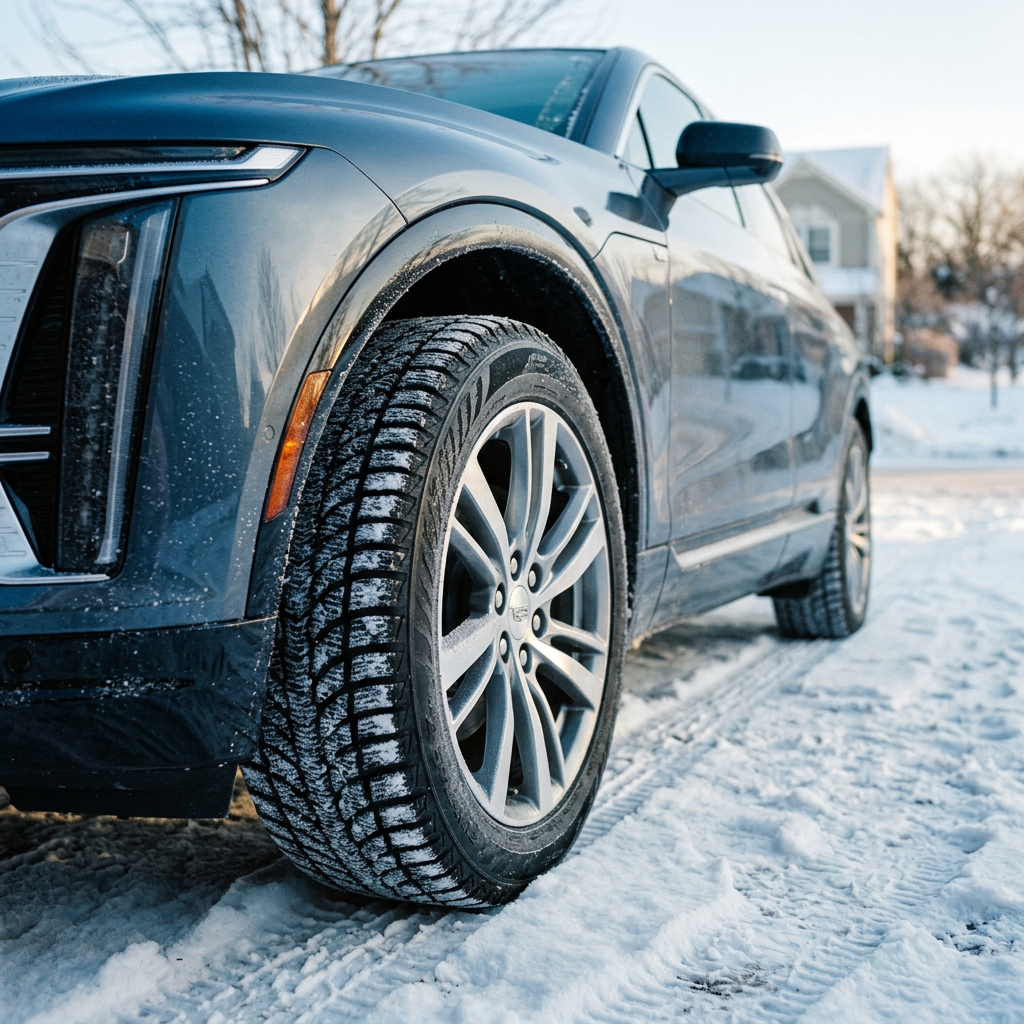
An official Cadillac winter wheel and tire package for models like the LYRIQ or OPTIQ typically costs between $2,500 and $4,200, depending on wheel diameter, finish, and tire specifications. Complete packages include factory-certified aluminum wheels, specialized winter tread compound tires, tire pressure monitoring sensors (TPMS), and installation. Why Dedicated Winter Tires Are Vital for EVs: Electric luxury vehicles deliver instantaneous electric torque and carry substantial curb weights due to low-mounted battery packs. Standard all-season rubber compounds harden when temperatures drop below 45°F (7°C), drastically reducing mechanical grip. Dedicated winter tires feature pliable silica compounds and high-density 3D sipes designed to bite into packed snow and black ice, cutting braking distances by up to 30 feet at highway speeds.
Electrical Panel Requirements: Hardwired 60-Amp Circuits vs NEMA 14-50 Plug-In Installations
NEMA 14-50 Plug-In
Max Breaker: 50-Amp Continuous Load (80% rule): 40 Amps (9.6 kW) Connection: Wall Outlet Plug Under National Electrical Code (NEC), plug-in outlets are restricted to a maximum 50-amp breaker, limiting continuous delivery to 40 amps. NEMA 14-50 outlets also require GFCI breakers and heavy-duty industrial sockets to withstand continuous high heat loads without thermal melting risks.
Hardwired 60-Amp Circuit
Max Breaker: 60-Amp Continuous Load (80% rule): 48 Amps (11.5 kW) Connection: Direct Conduit Wiring Hardwiring connects heavy 6-gauge copper wire directly inside the charger enclosure. By eliminating plug contacts, hardwiring safely supports a 60-amp circuit breaker for full 48-amp continuous delivery—providing the max 11.5 kW necessary for seamless sub-zero pre-conditioning.
Panel Capacity Needs
Recommended Service: 200-Amp Main Service Panel Adding a dedicated 60-amp double-pole breaker requires available electrical capacity. Most modern 200-amp main panels can easily accommodate a 60A circuit. Homes with older 100A or 125A panels may require a service panel upgrade or intelligent load-management device before installing a 48A charger.
Real-World Chicagoland Winter Range Expectations for Cadillac Electric Vehicles
In extreme sub-zero weather across northern Illinois, all electric vehicles experience range reduction due to air density changes, cabin heating demand, and battery thermodynamics. On average, drivers should anticipate a **20% to 30% reduction in total driving range** during severe winter cold snaps. However, by pairing a hardwired 48-amp charger for complete pre-conditioning with smart driving habits (such as utilizing One-Pedal Driving and setting target cruise speeds), you dramatically shrink range impact. Pre-conditioned Cadillac EVs routinely maintain over 75% to 80% of their rated range even during brutal zero-degree commutes across Will County.
Schedule Your EV Winterization Service and Accessories Consultation at Hawk Cadillac
Ensure your electric vehicle is fully prepared to conquer northern Illinois winter weather. At Hawk Cadillac in Joliet, IL, our team of factory-trained EV technicians is ready to assist you with complete winter readiness inspections, official Cadillac Level 2 home charging hardware, factory winter wheel and tire packages, and custom myCadillac app configuration. Visit our state-of-the-art facility located conveniently at 2001 W Jefferson St, Joliet, IL 60435. You can Get Directions to Hawk Cadillac or Call us at (815) 600-7027 to schedule your personalized EV consultation today. You can also explore flexible financing options with our online tool to Get Pre-Approved for Financing or evaluate your trade-in value with Value Your Trade.