Cadillac AWD vs. Traditional Truck 4WD for Northern Illinois Winters: The Direct Answer
When severe winter weather rolls across the plains and settles over northern Illinois, drivers from Plainfield to Naperville and Joliet face a landscape of unpredictable driving conditions. The debate between luxury all-wheel drive (AWD) and traditional pickup four-wheel drive (4WD) is more than academic—it determines your stability, reaction speed, and comfort when navigating freezing drizzle, packed snow, and sudden patches of black ice.
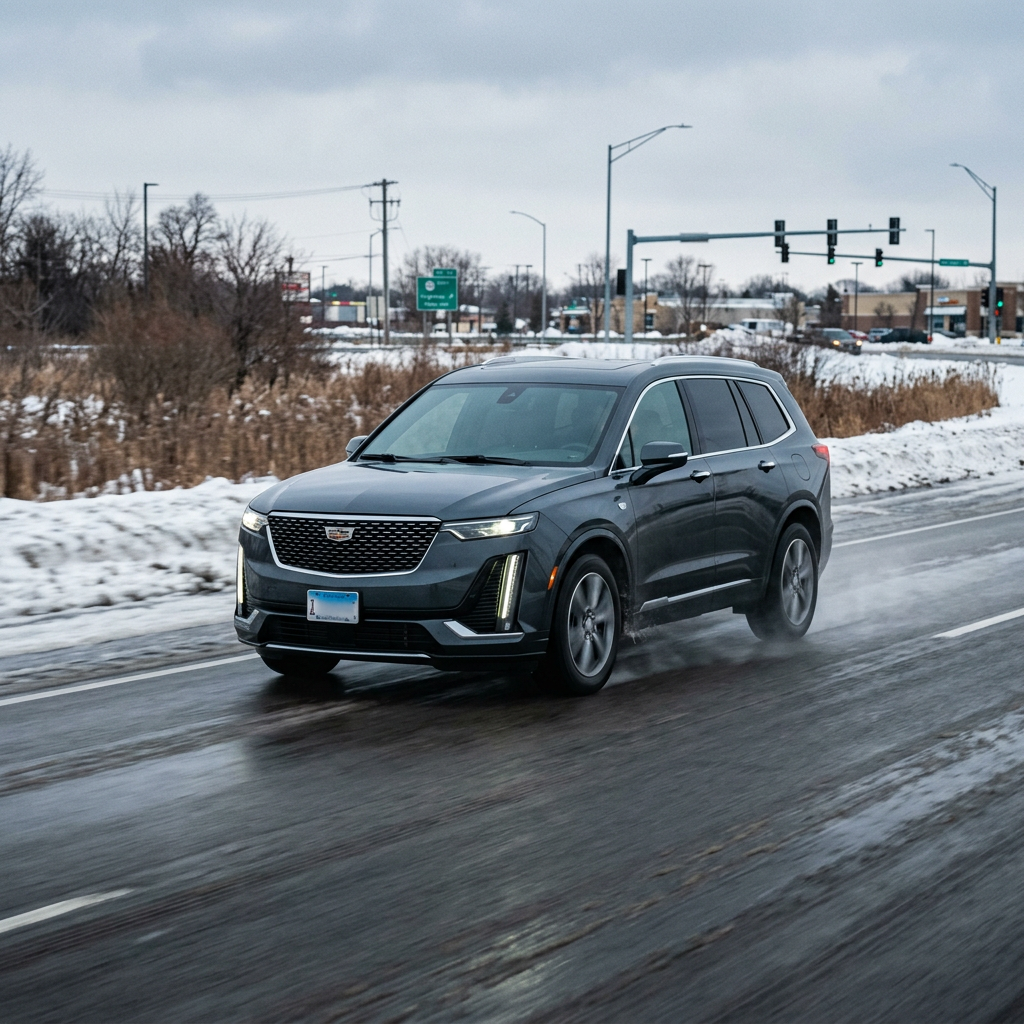
The practical takeaway is this: Cadillac intelligent all-wheel drive is engineered for the complex, microsecond-by-microsecond variations of daily northern Illinois winter roads. Traditional truck 4WD relies on a rigid mechanical transfer case designed to lock front and rear propeller shafts together at a fixed 50/50 ratio. While a part-time truck 4WD system is unmatched in unplowed farm fields or deep rural snow drifts exceeding 8 to 10 inches, it is fundamentally mismatched for the rapidly changing surface conditions encountered on commuter routes such as Interstate 55 and Route 59. In contrast, modern Cadillac AWD systems—such as the advanced twin-clutch electronic torque-vectoring architectures available on models like the XT4, XT5, XT6, and the instantaneous dual-motor electronic AWD found in the LYRIQ and ESCALADE IQ—monitor wheel slip, steering wheel angle, lateral acceleration, and throttle position hundreds of times per second. Without requiring the driver to flip a mechanical toggle or disengage the system when pulling onto dry, salted highway pavement, Cadillac AWD seamlessly shuffles engine torque to whichever individual wheel possesses the strongest mechanical grip. The result is instant, proactive poise across black ice, slush ridges, and slick suburban intersections.
Drivetrain Mechanics Explained: Full-Time Cadillac AWD vs. Part-Time Truck 4WD
Cadillac Intelligent All-Wheel Drive Cadillac passenger SUVs utilize an intelligent AWD architecture that incorporates an active power transfer unit and, on performance-oriented trims, a twin-clutch rear differential. Rather than mechanically locking the axles, this sophisticated layout employs wet multi-plate clutch packs actuated by high-precision electromechanical solenoids. Because there is no rigid center mechanical lock, the Cadillac system permits rotational speed differentiation between the front and rear wheels during cornering. This allows the vehicle to safely remain in AWD mode at any speed on any pavement condition—from wet asphalt to dry concrete and hard-packed snow—without mechanical strain or bucking.
Traditional Truck Part-Time 4WD Traditional body-on-frame pickup trucks typically rely on a conventional two-speed transfer case (with 2Hi, 4Hi, and 4Lo settings). When 4Hi is selected, a shift fork slides a collar that locks the front and rear driveshafts together at identical rotational speeds. Because the vehicle lacks a center differential, all four tires must travel at identical speeds. When a truck driver attempts to execute a sharp turn on wet or salted pavement, the front wheels are forced to travel a wider arc than the rear. With nowhere for the kinetic energy to release, the drivetrain experiences severe 'driveline binding' or 'crow-hopping,' which can induce loss of lateral traction or cause premature mechanical wear.
|
Mechanical Attribute
|
Cadillac Intelligent AWD
|
Traditional Truck Part-Time 4WD
|
|
Center Differential / Coupling
|
Active electronic multi-plate / twin-clutch
|
Rigid mechanical lock (chain/gear transfer case)
|
|
Safe on Cleared / Salted Pavement
|
Yes (active 100% of the time without wear)
|
No (causes drivetrain binding and tire scrub)
|
|
Torque Vectoring Capability
|
Millisecond variable split (front-to-rear and side-to-side)
|
Fixed 50/50 front/rear split only
|
|
Driver Intervention Required
|
None; proactive automated response
|
Manual engagement via dash switch or lever
|
|
Deep Snow Clearance (>10 in)
|
Moderate (ground clearance dependent)
|
Exceptional (high chassis lift & mechanical low range)
|
How Cadillac All-Wheel Drive Operates in Changing Winter Weather Along Route 59
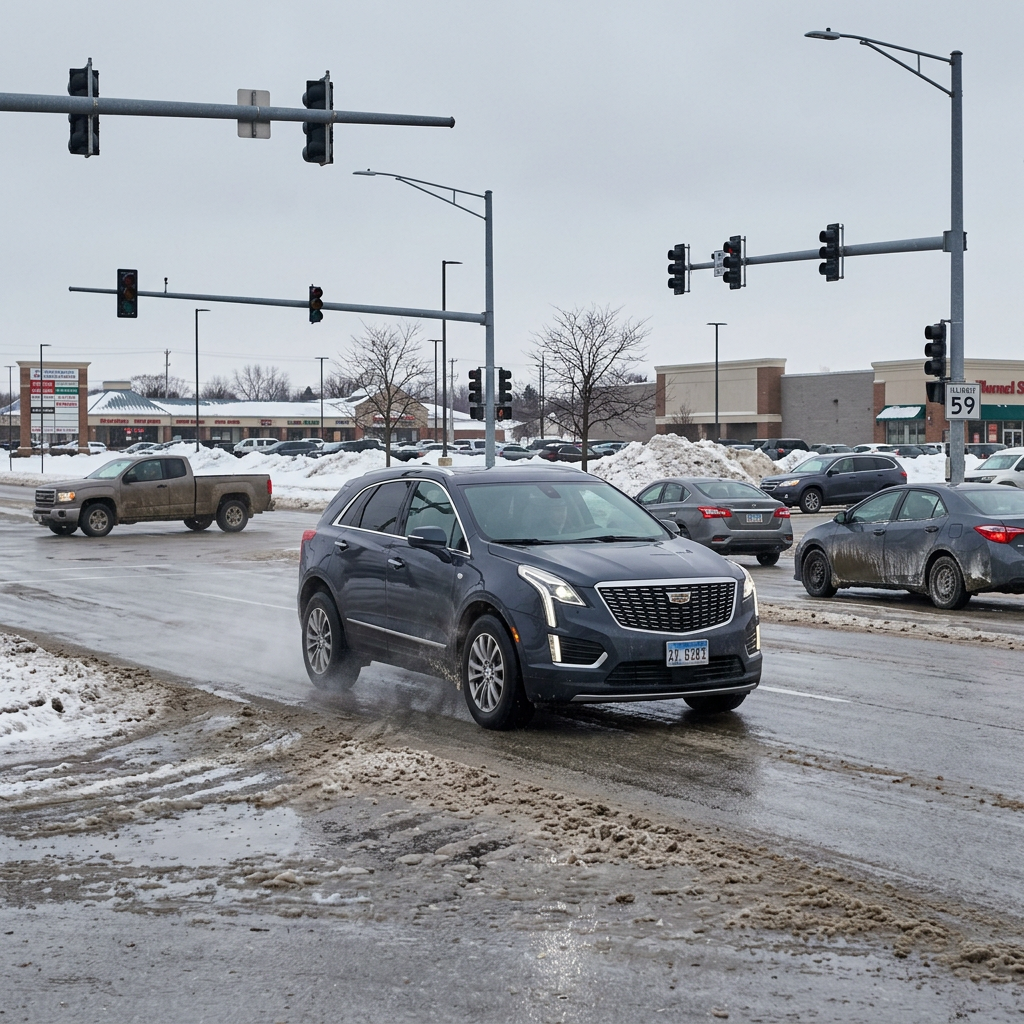
State Route 59 between Joliet, Plainfield, and Naperville is one of the busiest corridors in Will County. During a standard January squall, this corridor presents a demanding obstacle course: heavily salted, warm center travel lanes transition into slush-choked turning lanes, slick bridge overpasses, and polish-iced intersections where idling vehicles melt and refreeze packed snow. In these high-frequency transition zones, traditional truck drivers often leave their vehicles in 2WD to prevent driveline hop when negotiating tight strip-mall turns, leading to unweighted rear-wheel spin when accelerating from a dead stop. Cadillac AWD eliminates this compromise entirely. Cadillac vehicles equipped with twin-clutch AWD continuously evaluate input signals: ambient temperature sensors, windshield wiper activation, steering wheel angle, and throttle request rate. If the driver begins pulling out onto Route 59 from 135th Street, the Cadillac pre-charges the rear clutch packs before slip can even materialize. When the right-side wheels hit an icy slush gutter while the left-side tires remain on treated tarmac, the system distributes drive torque across the axle to prevent the vehicle from pulling off line, preserving crisp directional heading and peace of mind.
What Cadillac Snow/Ice Drive Mode Does on Slick Pavement
Cadillac's Drive Mode Selector provides tailored vehicle calibrations for severe conditions. When drivers engage Snow/Ice Mode via the center console control, the vehicle's electronic control modules coordinate changes across three critical subsystems to maximize stability and prevent traction loss.
Throttle Mapping
Snow/Ice mode electronically dampens the accelerator pedal curve. Even if the driver aggressively depresses the throttle from a stop, the engine control module filters the input to meter out horsepower and torque smoothly. This prevents sudden spikes in power that break tire friction on glazed snow or ice.
Transmission Calibration
The 9-speed and 10-speed automatic transmissions adjust shift points to upshift earlier in the rev range, keeping engine rpm low and torque delivery gradual. In certain Cadillac models, the transmission initiates acceleration from second gear rather than first to curb low-end torque multiplication at standstill.
AWD Torque Distribution
The all-wheel-drive system adopts an aggressive proactive bias, establishing a balanced front-to-rear power distribution. Rather than waiting for slip to occur before routing torque, power is actively directed across both axles continuously, maintaining balance through gentle steering corrections.
High-Speed Highway Stability: Cadillac StabiliTrak on I-55 Winter Commutes
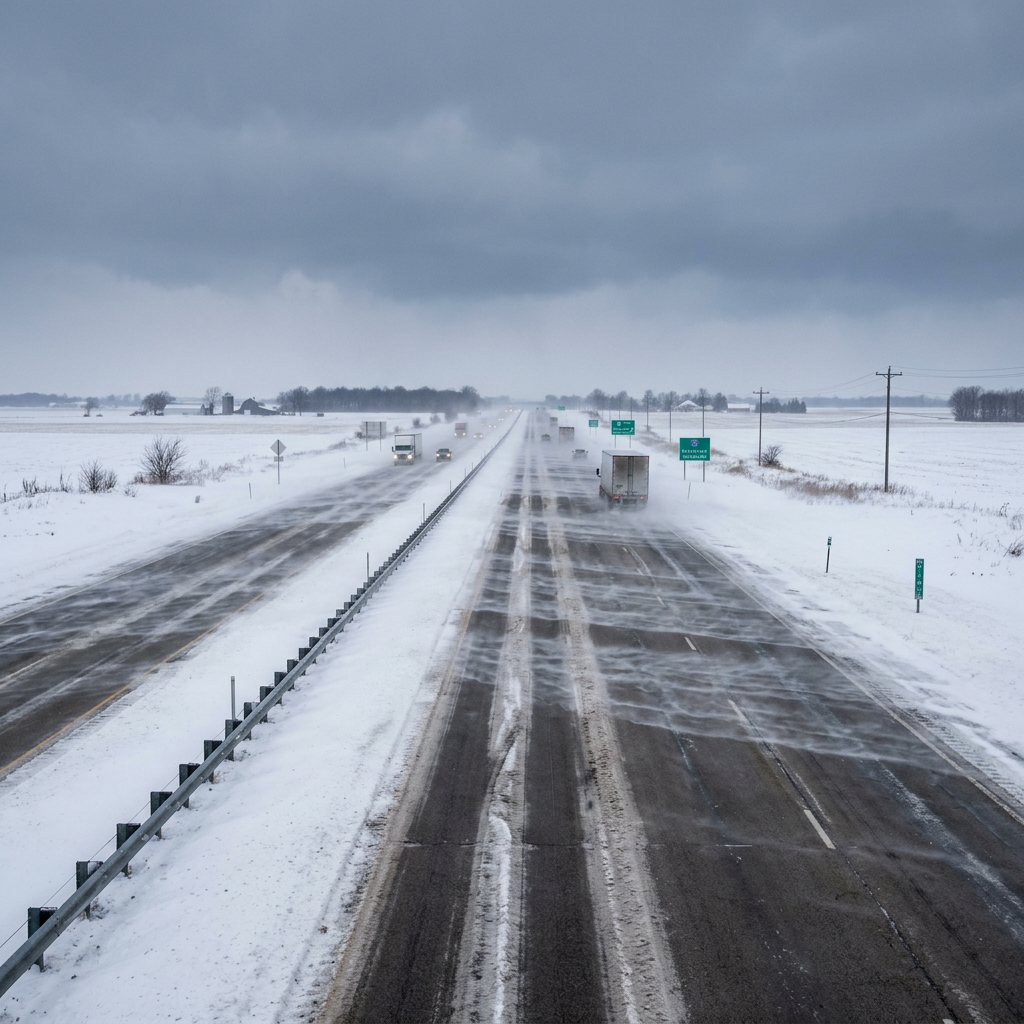
Commuting between Joliet and downtown Chicago on Interstate 55 during winter presents a distinct safety challenge: high cruising speeds coupled with sudden aerodynamic and surface disturbances. Open farmland between Plainfield and Bolingbrook acts as a natural wind tunnel, whipping 45-mph crosswinds across the road while snow ruts pack between lanes. A light-rear traditional pickup truck in 4WD can feel skittish in these circumstances. If a pickup encounters high-speed wind shears while straddling frozen ruts, its stiff solid rear axle and light bed can produce tail-wagging or sudden lateral yaw. Cadillac vehicles counteract these forces through an integrated suite centered around StabiliTrak. By continuously measuring yaw rate, lateral acceleration, and steering input, StabiliTrak can detect when the car's actual path deviates from the driver's intended line by mere fractions of a degree. If a frozen semi-truck rut tries to kick the vehicle sideways, StabiliTrak applies brake pressure to a single wheel—such as the inside rear wheel during understeer, or the outside front wheel during oversteer—to create a counter-rotational moment that pulls the chassis straight.
What Is the Difference Between Cadillac StabiliTrak and Traction Control?
While often used interchangeably in casual conversation, Traction Control and StabiliTrak Electronic Stability Control serve two separate, complementary functions in your Cadillac vehicle. Understanding their distinct roles helps you master winter driving dynamics across northern Illinois.
Cadillac Traction Control System (TCS)
Primary Focus: Longitudinal Control (Forward Motion) Traction Control is designed specifically to prevent wheel spin under acceleration. When wheel speed sensors identify that one drive wheel is spinning substantially faster than the rest—such as when pulling away from an icy red light at Jefferson Street and Larkin Avenue—TCS intervenes. It does this by pulsing the hydraulic brake on that individual wheel while reducing engine torque output until traction is restored. Key Takeaway: Traction Control keeps you moving forward without burning rubber or polishing ice beneath your tires.
Cadillac StabiliTrak (ESC)
Primary Focus: Lateral Control (Directional Stability) StabiliTrak is an advanced lateral stability system. It monitors where you are steering versus where the vehicle is actually tracking. If the vehicle begins to spin out (oversteer) or pushes straight through a turn despite turned wheels (understeer), StabiliTrak intervenes with precise individual wheel braking to restore balance. Key Takeaway: StabiliTrak works to prevent spins, rollovers, and loss of directional control during emergency evasive maneuvers or sudden ice encounters.
Deep Snow Drifts vs. Patchy Black Ice: Which Drivetrain Wins Where?
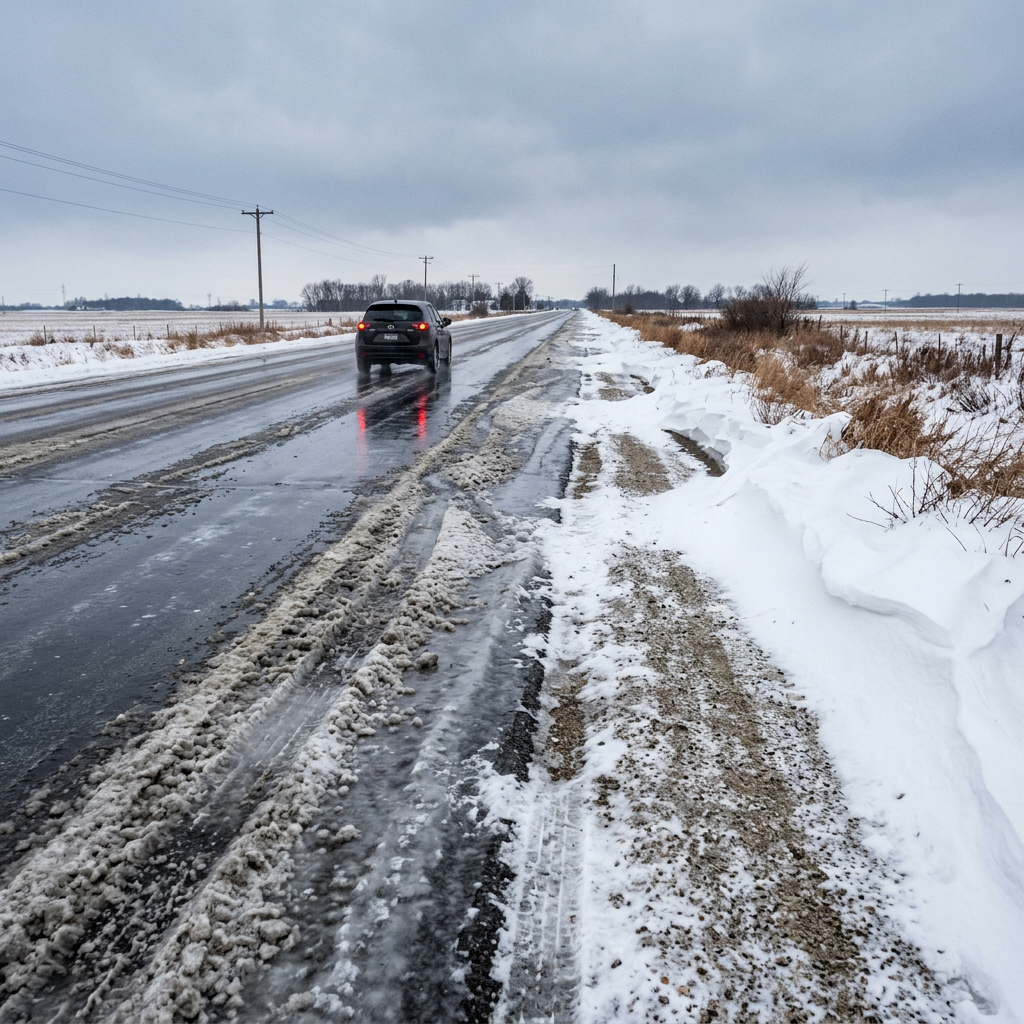
Scenario 1: Patchy Black Ice
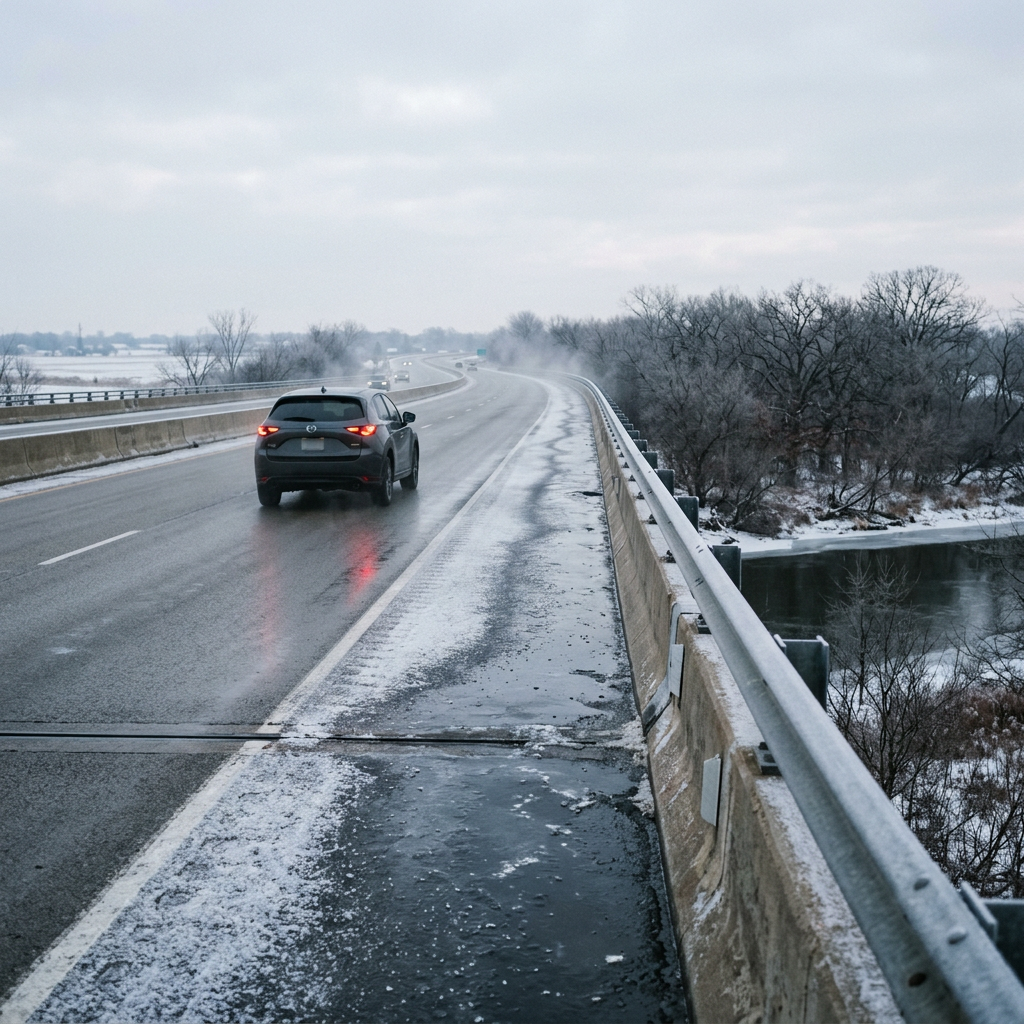
Cadillac AWD advantage Invisible black ice often coats bridges over the Des Plaines and DuPage rivers while surrounding pavement appears dry. Cadillac AWD detects micro-slips instantaneously and balances torque without driver input, keeping the vehicle stable. A truck in 2WD will spin out, while a truck locked in 4WD can experience front-axle push.
Scenario 2: Slush & Variable Highway
Cadillac AWD advantage When navigating typical commuter routes with slush berms between lanes, Cadillac AWD combines intelligent torque vectoring with four-wheel independent suspension. The SUV stays firmly planted when crossing ridges to change lanes, avoiding the unsettled chassis bounce common in stiff, solid-axle trucks.
Scenario 3: Unplowed Rural Drifts
Traditional Truck 4WD advantage If you live on an unpaved county road in southern Will County where a blizzard dumps 12 inches of heavy snow, high ground clearance and mechanical low-range 4WD give trucks an advantage. Once snow depth exceeds a crossover's bumper height, sheer mechanical clearance matters most.
Can Cadillac AWD Replace the Need for Winter Tires in Cold Climates?
A common misconception among Midwest drivers is that having all-wheel drive eliminates the need for dedicated winter tires. While Cadillac's advanced AWD will help you accelerate from a dead stop on packed snow, it cannot alter the fundamental laws of rubber friction. The 45-Degree Rule & Glass Transition: Standard all-season tires are engineered from chemical compounds designed for moderate warmth. Once ambient temperatures dip below 45°F—a constant reality in northern Illinois from November through March—the tread rubber stiffens, losing its pliability. It effectively turns into hard plastic, significantly reducing mechanical interlocking with the road surface. Dedicated winter tires, by contrast, utilize specialized hydrophilic rubber compounds infused with high concentrations of silica that remain pliable well below zero degrees. They also incorporate thousands of microscopic 3D sipes—tiny zigzag slits that create biting edges and trap snow crystals, utilizing snow-on-snow friction to generate adhesion.
AWD Helps You Go; Tires Help You Stop It is vital to remember:all vehicles already feature four-wheel braking. When you slam on the brakes on icy Essington Road in Joliet, an AWD Cadillac and a 2WD compact car rely on the exact same contact patches to stop. All-wheel drive delivers zero mechanical advantage when braking or negotiating emergency evasive steering maneuvers. Independent testing shows that on packed snow, dedicated winter tires can reduce stopping distances from 30 mph by 30 to 45 feet compared to all-season tires—often the difference between stopping safely and an intersection collision. Pairing Cadillac's responsive all-wheel drive with certified winter tires creates an optimal safety configuration for extreme Midwest winters.
Navigating Winter Driving Along Route 59 and I-55 with Cadillac AWD and StabiliTrak
Safe winter commuting across Will and Cook counties requires blending automotive engineering with defensive driving techniques. Here are practical strategies for local corridors: • DuPage River Bridge Crossings: Elevated spans along Route 59 freeze well before surface-level asphalt because cold air circulates above and below the bridge deck. When approaching bridges near Plainfield, ease off the accelerator and let Cadillac AWD maintain steady momentum rather than making sudden throttle adjustments. • Managing Lane Ruts on I-55: Heavy commercial traffic frequently leaves deep snow and slush ruts between lanes. When executing a lane change, do not fight the wheel. Allow StabiliTrak and the independent suspension to absorb the transition smoothly, keeping steering inputs progressive and gentle. • Expanded Following Distances: Cold temperatures lengthen stopping times. Maintain a 6-to-8-second buffer behind preceding traffic, especially when approaching busy intersections like Route 59 and 95th Street in Naperville.
Pre-Winter Readiness: Do Cadillac Dealers Offer Seasonal Vehicle Inspections?
Yes. Proper maintenance is critical to ensuring your Cadillac's AWD systems and safety electronics perform when temperatures drop. At Hawk Cadillac in Joliet, factory-trained technicians perform comprehensive multi-point winter inspections tailored to northern Illinois driving conditions.
Electrical & Fluids
Freezing temperatures can reduce battery cranking capacity by over 50%. Technicians conduct cold-cranking amp (CCA) load tests and refractometer freeze-point tests on engine coolant to ensure freeze protection down to -30°F.
Tires & Braking System
Braking balance is essential for StabiliTrak operation. Certified technicians inspect brake pad thickness, rotor runout, and electronic parking brake calipers, while measuring tire tread depth across multiple inner, center, and outer grooves.
Chassis & Visibility
Potholes along Route 59 alter wheel alignment, confusing steering angle sensors used by StabiliTrak. Techs verify multi-axis alignment, inspect suspension bushings, and install winter wiper blades with heavy-duty rubber boots.
Everyday Fuel Efficiency and Passenger Comfort Across Will County Winters
Beyond active safety and traction, living with a winter daily driver involves everyday operating costs and cabin comfort. Full-size pickup trucks carry significant weight penalties—often tipping the scales between 5,500 and 6,500 pounds—with heavy rotating transfer cases and solid differentials that create substantial parasitic drag. Modern Cadillac crossovers like the XT4, XT5, and XT6 incorporate an intelligent driveline disconnect system. When road conditions are dry and clear, the system mechanically decouples the rear propshaft at the transmission output. This stops unnecessary rotating mass, delivering front-wheel-drive fuel economy during routine highway cruising while standing ready to re-engage all four wheels in a fraction of a second when wheel slip is sensed.
When sub-zero Arctic blasts sweep across northern Illinois, Cadillac interior amenities transform the morning commute. Features designed for winter comfort include: • Remote Engine & Cabin Preconditioning: Use the myCadillac mobile app to start your vehicle from inside your home, activating automatic heated seats and the heated steering wheel. • Acoustic Laminated Glass & Active Noise Cancellation: Triple door seals and insulated floor pans keep winter road slush spray, studded tire drone, and biting prairie winds outside the cabin. • Tri-Zone Climate Control: Rapid cabin warm-up ensures passenger comfort without fogging interior side windows or windshield edges.
Experience Cadillac All-Wheel Drive Performance at Hawk Cadillac in Joliet
Northern Illinois winters demand confidence behind the wheel. While traditional truck 4WD serves a purpose for deep off-road snowbanks, Cadillac's proactive all-wheel drive, StabiliTrak active stability control, and tailored drive modes provide the responsive precision needed for everyday winter commutes along Route 59, Interstate 55, and across Will County. At Hawk Cadillac, we invite drivers from Plainfield, Naperville, Shorewood, and Joliet to experience this engineering difference firsthand. Whether you want to explore our lineup of intelligent AWD luxury SUVs, consult our parts specialists on seasonal tire packages, or bring your current vehicle in for a certified winter inspection, our dedicated team is here to assist. You can also explore our pre-owned selection to Browse Used Inventory, apply online to Get Pre-Approved for Financing, or check current market rates to Value Your Trade before visiting our showroom. Plan your visit today: Get Directions to Hawk Cadillac at 2001 W Jefferson St in Joliet, or speak directly with our team by giving us a Call (815) 600-7027.