
The Short Answer: Critical Warning Signs Your Cadillac Needs Immediate Wiper Blade Replacement
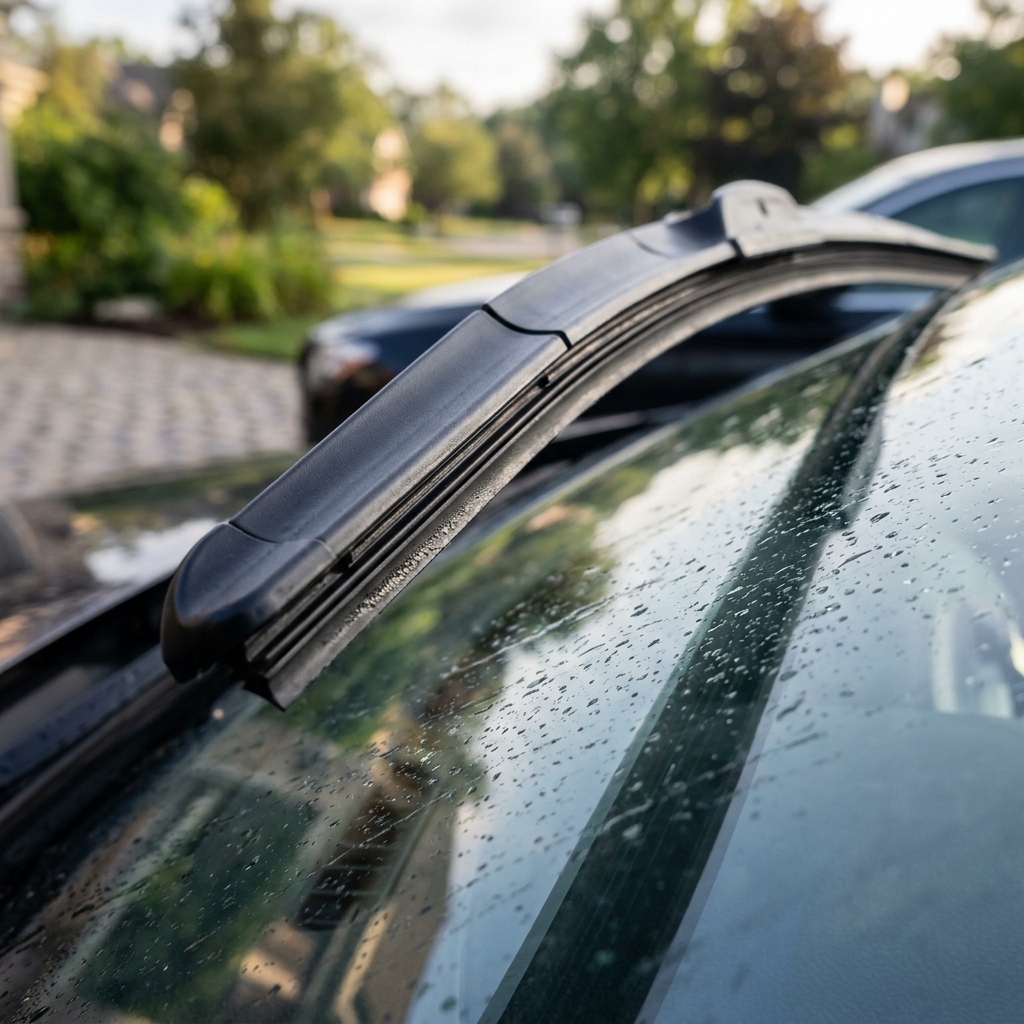
Close-up view of a black car windshield wiper blade resting on a wet glass windshield covered in water droplets. (Representative image for illustration purposes only. Actual vehicle may vary based on trim and configuration.)
When driving a modern Cadillac vehicle—whether navigating the rush hour traffic along Interstate 55 near Joliet or cruising smooth arterial roads through Plainfield and Naperville—uncompromised visual clarity is not merely a luxury; it is a foundational safety requirement. Cadillac luxury sedans and SUVs are meticulously engineered with sophisticated glass geometries, acoustic dampening windshields, and sensitive sensor suites. When your wiper blades begin to degrade, the immediate result is more than just a minor annoyance during a rainstorm—it is an active compromise of your luxury vehicle's performance and driver safety technology.
If you are looking for the direct answer, there are five critical warning signs that demand immediate wiper blade replacement on your Cadillac: 1) Severe streaking that leaves persistent film or bands across your field of view; 2) Chattering or violent skipping across the windshield surface; 3) Screeching or grinding noises during the wiping cycle; 4) Visible rubber splitting, cracking, or edge fraying along the squeegee element; and 5) Bent wiper arms or warped blade frames that prevent uniform glass contact pressure.
Ignoring these crucial symptoms can quickly lead to severe windshield scratching, distorted optics, and reduced effectiveness of essential active driver assistance features. Contemporary Cadillac models equipped with Super Cruise hands-free driving capability and automatic rain-sensing windshield wipers rely directly on front-facing optical cameras and infrared sensors embedded behind the upper windshield glass near the rearview mirror assembly. Worn wiper blades that leave streaks, smears, or water accumulation directly over these sensor zones can blind optical safety systems, triggering system drop-outs or unintended safety disengagements.
At Hawk Cadillac of Joliet, located conveniently at 2001 W Jefferson St, our factory-trained certified technicians encounter worn wiper assemblies daily. Routine inspection during every multi-point vehicle health check ensures your Cadillac maintains optimal visibility under all driving conditions. If you notice any of these five red flags, it is imperative to replace your wiper blades immediately using original equipment manufacturer (OEM) ACDelco or Genuine Cadillac wiper components.

Visual and Auditory Indicators of Worn Wiper Blades
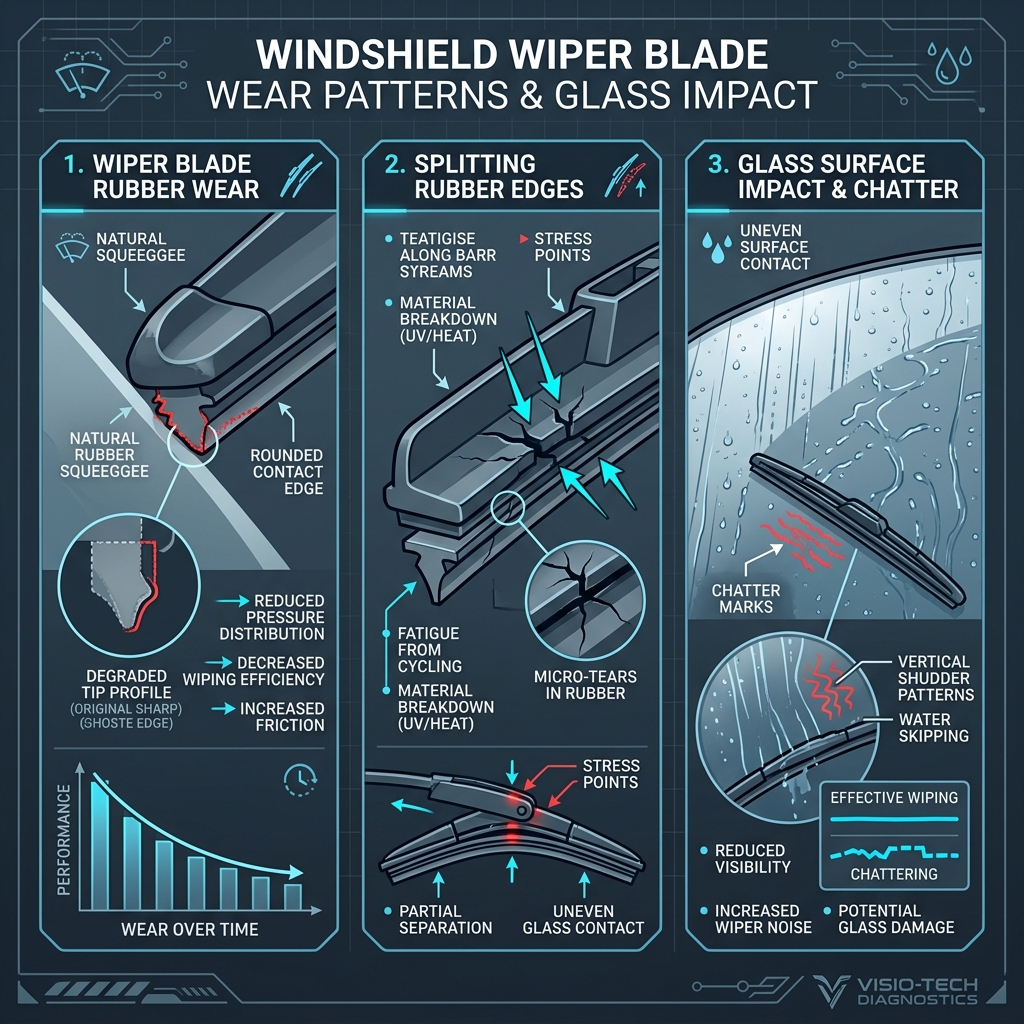
Recognizing the earliest physical signs of wiper blade degradation allows Cadillac owners to replace worn components before driving in hazardous weather conditions becomes dangerous. Degradation typically reveals itself through distinct visual patterns on the windshield and audible cues during operation.
Visual Film Buildup and Water Bands: When rubber squeegees age, oxidation and solar exposure degrade the flexible wiping edge. Instead of cleanly shearing rainwater off the hydrophobic windshield glass, worn blades leave a hazy film or wide, continuous bands of un-wiped water. In low-light conditions or night driving against oncoming headlights, this remaining film creates intense glare and halos, reducing visual reaction times dramatically.
Lace Streaking and Droplet Smearing: Thin, thread-like lines across the wipe path indicate micro-tears or tiny debris notches along the rubber squeegee edge. As the blade sweeps, water passes right through these small imperfections, leaving narrow bands of moisture directly in the driver's primary line of sight.
Infographic detailing three stages of windshield wiper blade wear and their impact on glass surfaces. (Representative image for illustration purposes only. Actual vehicle may vary based on trim and configuration.)
High-Pitched Screeching and Friction Grinding: Healthy flexible rubber sweeps silently across smooth windshield glass lubricated by rain. However, as rubber loses its pliable oils and hardens into rigid plastic-like material, high friction creates an ear-piercing squeal or high-pitched screeching sound. If metal blade backing structure touches the glass, high friction produces a harsh grinding noise that can permanently score expensive luxury glass assemblies.
Violent Skipping and Blade Chatter: When a wiper arm sweeps forward, the rubber edge must flip slightly so it trails behind the wiping force. Hardened rubber or twisted blade frames lose this flexibility, causing the wiper edge to drag, catch, and violently bounce or skip across the windshield glass. This chatter leaves rhythmic semi-circular missed patches across the windshield, accompanied by jarring thumping noises inside the quiet Cadillac cabin.

Why Are Your Cadillac Wiper Blades Leaving Streaks or Skipping Across the Glass?

It can be frustrating when brand-new wiper blades—or blades that are only a few months old—begin leaving broad streaks or skipping jerkily across your Cadillac's windshield. Drivers often wonder: Why are my brand new wiper blades failing to sweep cleanly? Understanding the underlying physical and environmental mechanics helps prevent premature blade failure.
Road Grime and Environmental Contamination: Vehicles driving around Will County and the greater Joliet area are continuously exposed to industrial particulate airborne fallout, tree sap, bug residue, diesel exhaust oils, and pitch. These chemical contaminants form an invisible sticky film over windshield glass and bond directly to the microscopic pores of natural rubber squeegees. When the blade attempts to sweep, this sticky residue disrupts smooth glide action, resulting in localized streaking.
Windshield Wax and Automotive Polish Buildup: Automatic car washes frequently apply spray-on liquid waxes or ceramic glass sealants. While these coatings encourage rain bead-off at high speeds, they can leave an uneven chemical residue across windshield wiper operational paths. When wiper blades push water across wax buildup, the variation in surface friction causes the rubber element to stutter, jump, and chatter.
Hardened Squeegee Rubber & Friction Set: Rubber compounds rely on natural elastomer oils to maintain flexibility. Extreme temperature shifts and UV exposure cause these oils to evaporate, a process known as dry rot or thermal hardening. Once rubber loses its elastic memory, it cannot flip orientation at the end of each wiping stroke. Instead of smoothly dragging behind the wiper arm, the rigid edge stubs against the glass, generating noticeable chatter.
Improper Wiper Arm Tension and Geometry: Cadillac wiper arms utilize heavy-duty internal steel tension springs designed to press the squeegee evenly against the complex curved glass geometry of models like the Escalade, XT5, or CT5. Over time, automatic car wash brushes or manual lifting can stretch internal tension springs or twist the wiper arm metal. Uneven arm tension creates localized pressure gaps where water is missed entirely.

How Northern Illinois Weather Affects Wiper Replacement Timing
Summer Heat & High UV Exposure

During humid Northern Illinois summers in Plainfield and Joliet, extreme solar ultraviolet rays relentlessly bake vehicles parked outdoors. Windshield glass surfaces easily surpass 140°F under direct midday sunlight. This intense heat bakes synthetic and natural rubber compounds, evaporating protective chemical plasticizers. As a result, the flexible squeegee edge dries out, shrinks, and develops micro-cracks long before winter precipitation arrives.
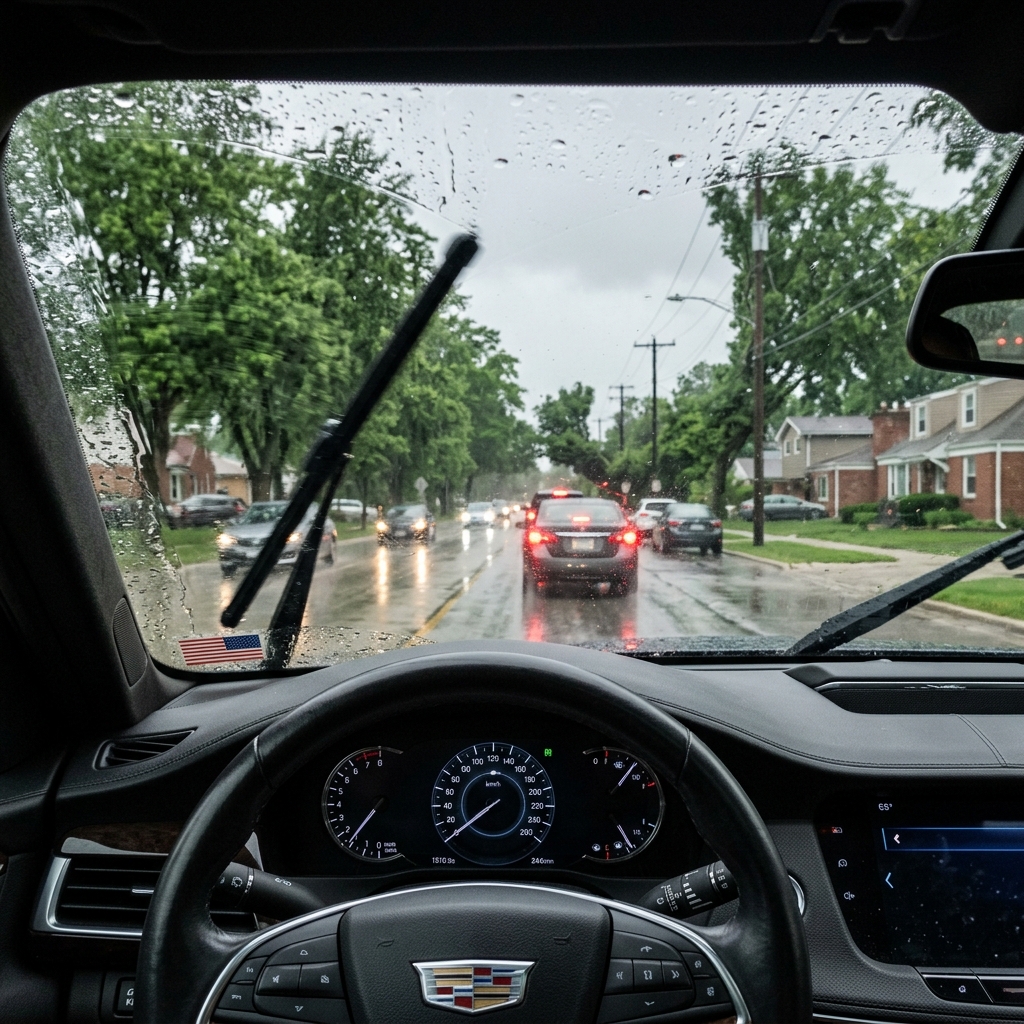
View from behind the steering wheel of a Cadillac driving on a rainy residential street with wipers moving. (Representative image for illustration purposes only. Actual vehicle may vary based on trim and configuration.)

Rapid Temperature Shifts

The Midwest climate is renowned for sudden atmospheric swings, where mild 65°F spring rain showers transition to freezing overnight temperatures within hours. Rapid thermal contraction and expansion subject wiper blade rubber to severe structural fatigue. Squeegee materials repeatedly stretch and compress, destroying structural integrity and causing localized edge warping.

Downpours & Heavy Debris

Severe Midwest convective thunderstorms demand max-speed wiper cycling across heavily loaded glass. Driving at highway speeds down Route 59 through Naperville during a deluge forces wiper arms to overcome intense aerodynamic wind drag while moving heavy water sheets. Worn, aged wiper blades instantly buckle under heavy hydrodynamic pressure, causing severe visual impairment.

Why Icy Winter Conditions Accelerate Windshield Wiper Blade Wear

While summer heat bakes rubber components, sub-zero winter freeze cycles across Joliet and Will County inflict catastrophic mechanical damage on Cadillac wiper blades. Cold weather fundamentally changes rubber chemistry, shifting soft elastomeric polymers into brittle, glass-like states susceptible to severe tearing.
Scraping Frozen Squeegees Across Ice Ridge Arrays: Turning on wiper blades when freezing rain or morning frost covers the glass is the single fastest way to destroy wiper squeegees. Dragging soft rubber across sharp frozen ice crystals acts like running a precision blade against 80-grit sandpaper. Tiny microscopic jagged ice edges tear chunks out of the thin wiping lip, creating permanent drag streaks.
Tearing Squeegee Lips from Frozen Glass Anchor Points: When parked overnight during winter storms, melted snow collects behind the wiper lip and freezes solid to the lower windshield glass header. If the wipers are activated before fully defrosting the windshield, the powerful electric wiper motor violently pulls the arm across the glass, ripping the delicate rubber squeegee straight off its steel retaining channel.
Heavy Slush and Packed Road Snow Load: Clearing thick, heavy slush thrown up by semi-trucks on Interstate 80 subjects wiper linkage arms, pivots, and blade frames to extreme torsional strain. Standard lightweight conventional frame blades easily bend under the weight of wet snow, ruining frame alignment and causing uneven glass contact.
Corrosive Liquid De-Icer and Salt Abrasives: Northern Illinois road crews apply heavy concentrations of rock salt, calcium chloride, and liquid brine to winter roadways. When kicked up onto the windshield, salt crystals act as fine abrasives between the squeegee rubber and glass surface. Furthermore, salt desiccates rubber compounds, stripping residual moisture and accelerating drying, hardening, and dry-rot cracking.

How Often Should Windshield Wiper Blades Be Replaced on a Cadillac?

As a rule of thumb, Cadillac engineering guidelines and professional service experts recommend replacing windshield wiper blades every 6 to 12 months. However, strict calendar schedules should always be secondary to actual blade condition and local climate exposure in Northern Illinois.
Drivers who store their Cadillac in a climate-controlled residential garage in Naperville and log low annual commuter mileage may safely reach 12 months on a single pair of premium OEM beam blades. Conversely, vehicles parked outdoors daily in Plainfield or subjected to high annual highway mileage along the I-55 corridor will often require replacement every 6 months—ideally once before severe winter freezes begin (late autumn) and once after spring thaw (early May).
If you are unsure of your current blade condition, you can inspect your wiper assemblies at home or have our experts inspect them during your next service visit. You can easily Schedule Your Service Today at Hawk Cadillac to keep your maintenance routine up to date.

Cadillac Wiper Replacement Interval Matrix

Driving Environment

Storage Condition

Recommended Interval

Highway Commuter (I-55 / I-80)

Outdoor Parking

Every 6 Months

Suburban Daily Driver (Joliet/Plainfield)

Driveway / Carport

Every 6 to 9 Months

Low Mileage / Weekend Use

Climate Garage

Every 12 Months

Severe Winter Exposure

Outdoor Street Parking

Spring & Fall (Bi-Annual)

What Type of Wiper Blade Lasts Longest on Premium Vehicles?

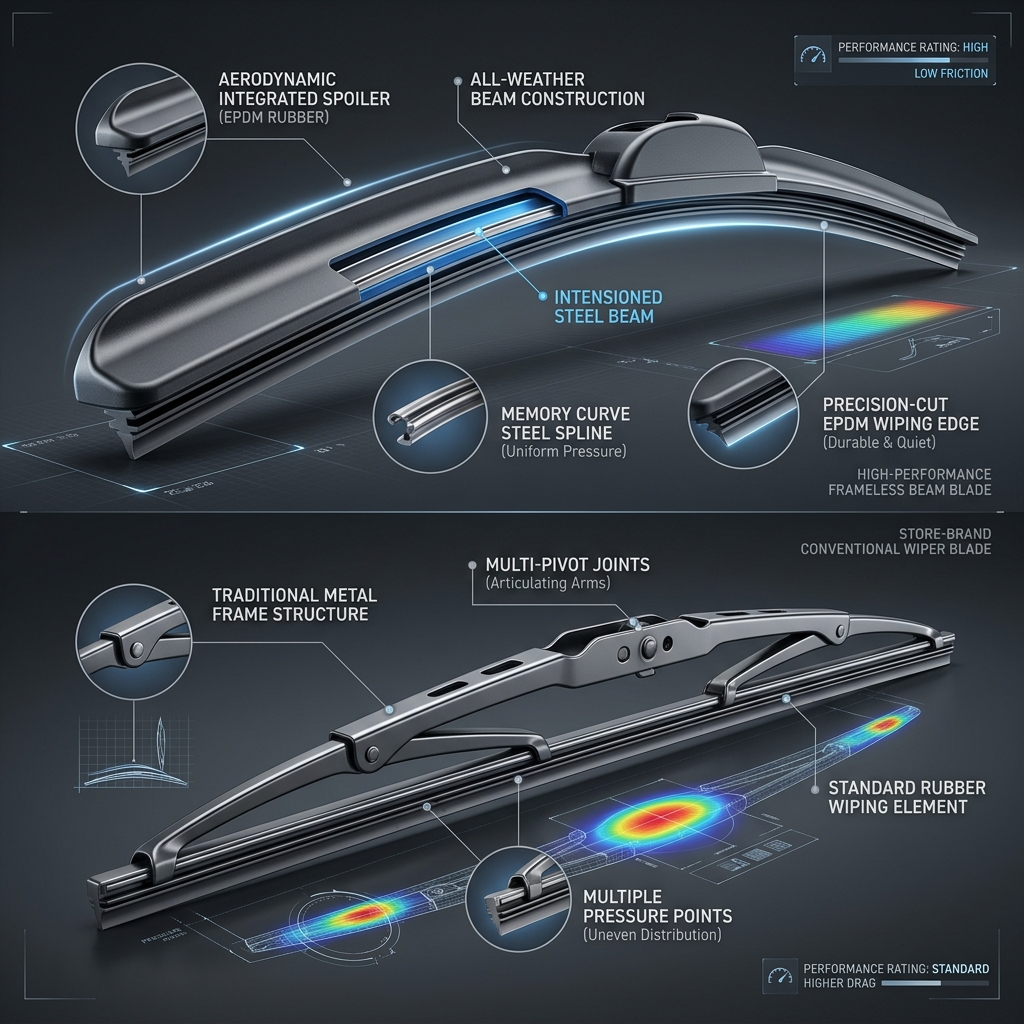
Conventional Frame Blades

Conventional wiper blades utilize an exposed metal bridge framework with metal claws holding a rubber squeegee strip at 4 to 8 contact points. While inexpensive, these traditional frames apply uneven point-load pressure across modern curved windshields. Furthermore, winter ice easily packs inside open metal hinges, freezing the framework solid and preventing contact with windshield glass.

Hybrid Wiper Blades

Hybrid wiper blades enclose a conventional metal frame structure within an aerodynamic plastic hard shell shroud. While offering improved wind drag resistance and better aesthetic integration than raw conventional frames, internal metal joints can still trap moisture, freeze during Northern Illinois winter storms, and fail to match complex windshield contours.

Beam/Frameless EPDM Blades

Beam-style frameless blades represent the absolute apex of wiper engineering and come standard on modern Cadillac vehicles. Utilizing memory-curve steel spring spines enclosed in continuous EPDM rubber or silicone compounds, beam blades distribute uniform pressure across the entire glass surface. They feature built-in spoilers to prevent high-speed wind lift and contain zero exposed mechanical joints to freeze.

OEM Genuine GM Wiper Blades vs. Generic Aftermarket Options
When shopping for replacement wiper blades at big-box auto supply stores, vehicle owners are confronted with dozens of generic universal options. However, replacing the factory blades on your Cadillac with generic aftermarket options frequently leads to disappointing wiping performance, annoying wind noise, and fitment frustration.
Precise Windshield Curvature and Sweep Radius Fitment: Genuine GM ACDelco OEM wiper blades are engineered specifically alongside Cadillac vehicle body designs. The internal steel beam tension curve is contoured to match the exact radius of your Escalade, XT4, XT6, CT4, or LYRIQ windshield glass. Generic aftermarket beam blades use a one-size-fits-all curve spring, often leaving broad un-wiped patches at the outer glass edges.
Integrated Washer Fluid Nozzles and Heated Systems: Many modern Cadillac luxury vehicles incorporate specialized washer fluid channels directly into the wiper blade arms or blade frames (such as GM's High-Pressure Washer System). Generic aftermarket blades lack these proprietary fluid fittings, rendering factory washer fluid distribution ineffective or leaking fluid across your hood.
Diagram comparing a high-performance frameless beam wiper blade to a conventional metal-frame wiper blade with pressure maps. (Representative image for illustration purposes only. Actual vehicle may vary based on trim and configuration.)
Rain Sensor and ADAS Optical Camera Compatibility: Rain-sensing automatic windshield wipers rely on precise light refraction calculations through the upper windshield glass zone. OEM ACDelco squeegee compounds sweep clean without leaving hydrophobic chemical film streaks that fool optical rain sensors into running erratically or stopping mid-storm.
Acoustic Noise Dampening and Low Profile Connectors: Cadillac interior cabins are celebrated for quiet serenity. Generic aftermarket blades often feature bulky universal connector clips that create aerodynamic turbulence and whistling noises at highway speeds. Factory OEM replacement blades snap directly into original arm attachments without unsightly multi-fit adapters.

A Quick 2-Minute DIY Wiper Inspection Checklist

Step 1: Tactile Squeegee Check

Lift the wiper arm away from the glass. Run your index finger smoothly along the entire length of the rubber squeegee lip. Feel for jagged nicks, split edges, missing chunks, or rigid, unyielding dry-rot sections. If the rubber feels hard like brittle plastic rather than pliable elastomer, it requires immediate replacement.

Step 2: Hinge Flex & Frame Test

Gently flex the wiper blade frame near the center connector attachment point. Ensure the locking connector tab is firmly latched without excessive lateral play or rust accumulation. Check that the internal metal spring spine bends evenly without permanent warps or bent metallic claws.

Step 3: Washer Fluid Wipe Test

Lower wipers back onto the glass. Activate your windshield washer fluid jets and perform 3 continuous wiping cycles. Observe the glass from the driver's seat. Look for immediate streak lines, chatter vibration, water film haze, or un-wiped zones directly within your line of vision or over sensor modules.
Maintaining your Cadillac's comprehensive safety system is simple. If you are exploring upgrading your vehicle or scheduling routine maintenance, you can also Get Pre-Approved for Financing online prior to visiting our showroom.

The Safety Risks of Driving with Compromised Windshield Visibility

According to automotive safety data published by the National Highway Traffic Safety Administration (NHTSA), over 20 percent of all vehicular crashes occur during adverse weather conditions involving rain, snow, sleet, or fog. Driving with worn or failing wiper blades exponentially increases collision risk by severely slowing driver perception and braking reaction time.
Impaired Driver Reaction Distance: At 65 MPH along I-55 in Joliet, your vehicle travels approximately 95 feet every single second. If worn wiper blades leave a heavy water smear or broad streak across your field of view for just two wipe cycles (about 3 seconds), you are effectively driving blind for nearly 300 feet. In sudden emergency stopping situations, those lost seconds make the difference between a safe stop and a severe rear-end collision.
Interference with Advanced Driver Assistance Systems (ADAS): Modern Cadillac luxury sedans and SUVs feature sophisticated active driver assist systems, including Forward Collision Alert, Automatic Emergency Braking, Lane Keep Assist, and Super Cruise. These systems rely heavily on optical camera modules mounted directly behind the top center of the windshield glass.
When worn wiper blades leave streaks, dirt smears, or water accumulation directly over the camera portal, the optical lens cannot clearly discern lane markings, leading vehicles, or pedestrian hazards. This can cause driver assist features to suddenly disengage or trigger warning alerts on your driver cluster display.

Professional Cadillac Wiper Installation and Service at Hawk Cadillac

When it comes to maintaining the safety, performance, and luxury of your vehicle, trust the factory-trained professionals at Hawk Cadillac. Serving drivers across Joliet, Plainfield, Naperville, and surrounding Will County communities, our state-of-the-art service facility offers comprehensive automotive care tailored precisely to Cadillac specifications.
Certified Cadillac Technicians & Full OEM Parts Inventory: Our certified service team stock a complete inventory of Genuine GM ACDelco beam wiper assemblies designed specifically for every Cadillac model year. We do not use generic multi-fit adapters—we install precise factory parts that maintain your vehicle's sleek aerodynamics and quiet operation.
Express Service Lanes with Complimentary Inspection: Replacing wiper blades at Hawk Cadillac is fast and effortless. Drive directly into our express service lane for rapid wiper replacement, windshield washer fluid top-off, and a complimentary multi-point safety inspection. If you are considering trading in your vehicle, you can also easily Value Your Trade online today.

Schedule Your Cadillac Wiper Service or Order OEM Parts in Joliet

Do not wait for a sudden torrential downpour on Interstate 55 or a sudden winter ice storm to reveal that your wiper blades have failed. Ensure continuous optical clarity, quiet operation, and optimal performance of your active safety camera systems by upgrading to fresh Genuine Cadillac OEM wiper blades today at Hawk Cadillac.
Visit our state-of-the-art facility at 2001 W Jefferson St, Joliet, IL 60435. You can Get Directions to Hawk Cadillac directly from your smartphone, or Call us at (815) 600-7027 to speak immediately with a service advisor. You can also Order Genuine Cadillac Parts online or Schedule Your Service Today.
Interested in exploring our latest showroom arrivals or quality pre-owned luxury vehicles? Take a moment to Browse New Inventory or Browse Used Inventory while your vehicle receives expert care.

 

Subscribe to Our Blog